

Algo Trading in India (2026): The Complete Guide for Retail Investors

For years, algorithmic trading in India was an exclusive club. Institutional desks, hedge funds, and HNIs with proprietary systems moved billions of rupees through automated strategies while retail investors watched manually, clicking buy and sell on their phones.
That era is over.
In 2026, algo trading in India is officially open to every retail investor — regulated, accessible, and increasingly no-code. The market has crossed ₹1,000 crore in platform infrastructure. Algo-driven orders now account for over 53% of the NSE cash market volume. And with SEBI's landmark framework live from April 1, 2026, the rules of the game are finally clear.
This is Fintrens' complete guide to algo trading in India in 2026 — covering everything from what it actually is, to how to start without writing a single line of code.
What Is Algo Trading? (And Why India Is at an Inflection Point)
Algorithmic trading, or algo trading, is the use of computer programs to execute buy and sell orders in the stock market automatically, based on pre-defined rules. Instead of a human watching a screen and manually placing orders, an algorithm monitors real-time market data and fires trades the instant specific conditions are met.
Think of it this way: you define the logic — "buy Nifty futures when the 20-day EMA crosses above the 50-day EMA, and sell when RSI crosses 70" — and the algorithm executes it instantly, without hesitation, without emotion, 24/5.
Why India Is at an Inflection Point in 2026
Three things have converged to make 2026 a turning point for retail algo trading in India:
1. SEBI's regulatory framework is now live. From April 1, 2026, every algorithm must carry an exchange-assigned ID. The rules are clear, the compliance path is defined, and retail traders finally have formal legal standing.
2. No-code platforms have matured. You no longer need Python or C++ to build and deploy a strategy. Platforms like Streak, AlgoTest, and uTrade Algos let you create, backtest, and automate strategies through drag-and-drop interfaces.
3. The market is enormous and growing. India's algorithmic trading market was valued at USD 562 million in 2024and is projected to reach USD 1.27 billion by 2033, growing at a CAGR of 9.5%. Retail investors are expected to hold the largest market share at 38.5% by 2026.
If you're a retail investor who hasn't explored algo trading yet, this is the most important moment to understand it.
Is Algo Trading Legal in India in 2026?
Yes — algo trading is completely legal in India for retail investors.
SEBI has not only permitted it but has actively created a regulated framework to make it safer and more accessible. Here is the regulatory timeline:
- February 2025: SEBI issued its circular on safer participation of retail investors in algorithmic trading, establishing the API-based framework
- August 2025: NSE implemented its comprehensive algo trading framework with mandatory strategy registration and enhanced API security
- April 1, 2026: Full compliance mandatory for all brokers — every automated order must now carry an exchange-generated Algo-ID
The key requirement: retail traders cannot connect directly to exchanges. All algorithms must run through a SEBI-registered broker's API. As long as you're using a compliant platform and broker, you're fully within the law.
How SEBI's 2026 Algo Trading Framework Works
Understanding the regulatory architecture helps you trade smarter and stay compliant. Here's what the framework actually says:
Algo-ID: The Foundation of the New System
Every order placed by an algorithm must carry an exchange-assigned Algo-ID — a unique identifier that lets regulators trace every automated trade back to its source. This is SEBI's primary tool for market surveillance and accountability.
The 10 OPS Threshold
SEBI draws a critical line at 10 orders per second (OPS) per exchange per client:
- Below 10 OPS: You're classified as a regular API user. No separate algo registration needed
- Above 10 OPS: Mandatory algo registration with the exchange is required
Most retail traders fall comfortably below this threshold.
White Box vs Black Box Algorithms
SEBI classifies all algos into two types:
White Box Algos: The strategy logic is transparent and replicable. If you're using a standard indicator-based strategy (moving average crossover, RSI, Bollinger Bands), this is you. White Box retail traders using personal strategies do not need separate SEBI registration.
Black Box Algos: The internal logic is hidden from the user — proprietary or AI-driven strategies. Providers of Black Box algos must be registered as Research Analysts with SEBI.
Technical Compliance Requirements
- Static IP whitelisting: Your broker whitelist your IP(s) for API access
- Mandatory OTP/2FA on all sessions
- Auto-logout before each trading day begins
- Indian server hosting: All retail algos must run on servers within India
- 5-year log retention: Brokers must maintain detailed API activity records
How to Start Algo Trading in India in 2026 (Step-by-Step)
Here is the most practical, no-nonsense path from zero to live algo trading in India:
Step 1: Build Your Market Foundation (Week 1–2)
Before any algorithm, you need to understand what you're automating. Spend time learning:
- How Indian equity and derivatives markets work
- Order types: market, limit, SL, SL-M
- Basic technical indicators: moving averages, RSI, MACD, Bollinger Bands
- How Nifty futures and options contracts are structured
You don't need to be an expert. You need to understand enough to define a rule-based trading logic.
Step 2: Choose Your Algo Platform (Week 2)
This is one of the most important decisions you'll make. Your platform determines what strategies you can build, how well you can backtest, and how smoothly execution works.
For no-code beginners:
- Zerodha Streak — integrated with Kite, easy-to-use strategy builder, solid backtesting
- uTrade Algos — comprehensive no-code builder, strong SEBI compliance documentation
- AlgoTest — best-in-class backtesting engine, especially for options strategies
For semi-technical traders (basic coding):
- Tradetron — cloud-based, supports Python integrations, large strategy marketplace
- Quantiply / Pi Bridge — for Angel One users
For advanced/institutional:
- AlgoBulls — full Python strategy deployment with AI-powered backtesting
Step 3: Set Up Your Broker API Access (Week 2–3)
Not all brokers offer API access. The most popular choices for algo trading in India are:
- Zerodha (Kite Connect API) — most widely used, extensive documentation
- Upstox API — reliable, growing ecosystem
- Angel One SmartAPI — free API access, good for beginners
- FYERS API — popular for options traders
- AliceBlue — newer but feature-rich
Complete your KYC, enable API access in your broker settings, obtain your static IP, and get whitelisted.
Step 4: Build and Backtest Your First Strategy (Week 3–4)
Start simple. Don't try to build a machine-learning arbitrage model on day one.
Proven beginner strategies for Indian markets:
- EMA Crossover on Nifty Futures — go long when 9 EMA crosses above 21 EMA, exit when it crosses below. Clean, rule-based, easy to backtest
- RSI Mean Reversion — buy when RSI drops below 30 on quality large-cap stocks, sell when RSI crosses 60
- Opening Range Breakout (ORB) — take a position in the direction of the break of the first 15-minute candle's high or low
For any strategy: backtest on a minimum of 2 years of historical data with at least 100 trades in the sample. Fewer trades = unreliable results.
Step 5: Paper Trade for 3–4 Weeks
Before a single rupee goes live, paper trade your strategy. Most platforms offer a simulated environment. Watch for:
- API latency vs backtest assumptions
- Partial fills on illiquid strikes
- Slippage on fast-moving expiry days
- Drawdown behaviour during high-volatility sessions
If the live paper behaviour diverges significantly from your backtest, stop and investigate before going live.
Step 6: Go Live with Small Capital
Start with the minimum capital required for your strategy. For most retail strategies:
- Equity intraday: ₹50,000–₹1,00,000
- Nifty futures: ~₹1,00,000+ margin
- Options strategies (straddle/strangle): ₹2,00,000–₹5,00,000
Scale capital only after 3–6 months of consistent, documented live performance.
Best Algo Trading Strategies for Indian Markets in 2026
These are the strategy categories that work best in India's market structure:
1. Trend-Following Strategies
Moving average crossovers, EMA ribbons, and ADX-based trend identification work particularly well on Nifty, Bank Nifty, and midcap futures during trending sessions (typically Tuesday–Thursday). India's markets have strong directional moves around RBI policy, budget events, and quarterly results.
2. Mean Reversion Strategies
Indian markets are known for sharp overnight gaps and aggressive intraday reversals. Mean reversion strategies — particularly RSI and Bollinger Band-based approaches on liquid large-cap stocks — have historically provided consistent edge in sideways markets.
3. Options Selling Strategies (High Probability)
Short straddles and strangles on weekly Nifty expiry are among the most widely deployed retail algo strategies in India. With the post-SEBI F&O reforms compressing speculative volatility, theta decay strategies benefit from more orderly premium behaviour.
Note: Options selling requires sufficient margin and a robust stop-loss mechanism. Always define maximum loss before deployment.
4. Opening Range Breakout (ORB)
Highly popular in India due to the predictable volatility at market open (9:15–9:30 AM). The algorithm captures the first 15 minutes' range and trades the breakout. Works especially well on Bank Nifty.
5. Statistical Arbitrage
For advanced traders: pair trading between correlated stocks (e.g., HDFC Bank vs ICICI Bank, Infosys vs TCS). Low-risk, market-neutral, but requires more technical implementation.
Common Mistakes Retail Algo Traders Make in India
Knowing what not to do is as important as knowing what to do:
Over-optimising (curve fitting): Building a strategy that fits historical data perfectly but fails in live markets. If your strategy has 95% win rate in backtesting, be very suspicious.
Ignoring slippage and transaction costs: Backtesting platforms often use ideal execution. In live markets, brokerage, STT, GST, and slippage eat significantly into thin-margin strategies. Always factor these in.
Skipping paper trading: Jumping from backtest to live is the single most common mistake. Paper trade for at least 3–4 weeks minimum.
Using too much leverage early: Futures and options leverage can amplify losses as fast as gains. Start with the minimum viable position.
No kill switch: Always build a manual override into your setup. Algos can behave unexpectedly in black-swan events (circuit breakers, network failures, data feed errors). Know how to shut your system down instantly.
Choosing a non-compliant platform: After April 1, 2026, any algo running without an exchange-assigned Algo-ID is non-compliant. Verify your platform's SEBI compliance status before deploying capital.
India's Algo Trading Market: Key Numbers in 2026
Here is the data that matters:
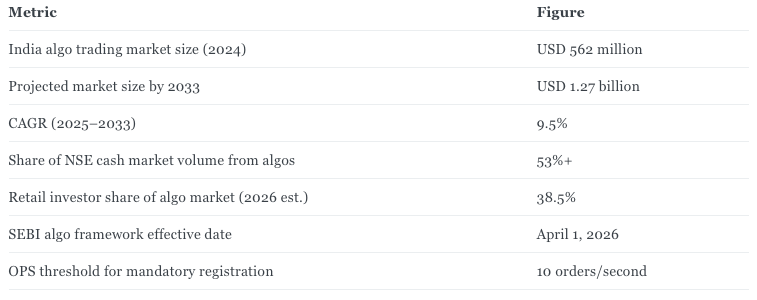
These numbers tell a clear story: India's retail algo trading market is not a niche — it is becoming the mainstream mode of market participation.
Algo Trading vs Manual Trading: Which Is Right for You?
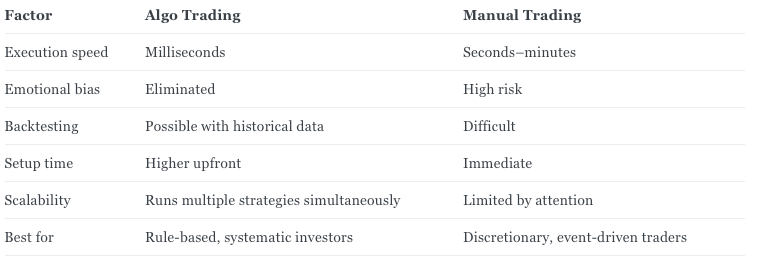
Algo trading is not inherently better than manual trading — it is better for a specific type of trader: systematic, rules-based, data-driven, and patient enough to build and test properly.
Frequently Asked Questions About Algo Trading in India
Q: Is algo trading legal in India for retail investors? Yes. Algo trading is completely legal for retail investors in India. SEBI issued its framework in February 2025 and made full compliance mandatory from April 1, 2026. All algorithms must run through SEBI-registered broker APIs with exchange-assigned Algo-IDs.
Q: How much money do I need to start algo trading in India? You can start with as little as ₹50,000 for equity intraday strategies. Futures-based strategies typically require ₹1–2 lakh in margin. Options selling strategies generally need ₹2–5 lakh to operate sustainably.
Q: Can I do algo trading in India without coding? Yes. Multiple no-code platforms like Zerodha Streak, uTrade Algos, and AlgoTest allow you to create, backtest, and deploy strategies using visual interfaces without writing code.
Q: What is the SEBI Algo-ID requirement? From April 1, 2026, every order placed by an algorithm must carry a unique exchange-assigned Algo-ID. This allows regulators to trace all automated trades. Your broker and platform handle this compliance layer for you.
Q: Which broker is best for algo trading in India? Zerodha (Kite Connect API), Upstox, Angel One SmartAPI, Dhan, and FYERS are among the most popular brokers for retail algo trading. Zerodha has the largest developer ecosystem; Angel One offers free API access.
Q: What is the difference between White Box and Black Box algo trading? White Box algos use transparent, replicable logic (e.g., moving average strategies). Black Box algos use hidden logic (AI/proprietary). SEBI requires Black Box algo providers to be registered as Research Analysts.
Q: How risky is algo trading? Algo trading carries the same market risks as manual trading — plus some unique risks like technical failures, API disconnects, and data feed errors. Risk is managed through proper backtesting, position sizing, stop-losses, and kill switches.
Q: What percentage of trading in India is algorithmic? As of 2025, algorithmic trading accounts for over 53% of the NSE cash market volume. This figure is expected to continue growing as retail adoption accelerates.
The Bottom Line: Why 2026 Is the Year to Start
The three barriers that kept retail investors out of algo trading — legal ambiguity, technical complexity, and platform immaturity — have all been addressed in 2026.
SEBI has defined the rules. No-code platforms have eliminated the coding barrier. The market infrastructure is ready.
What remains is the most human part: building the discipline to create a tested, rule-based strategy, resisting the urge to over-optimise it, and running it consistently over time.
India's capital markets are transitioning from a discretionary, screen-watching culture to a systematic, algorithm-driven one. The traders who understand this shift early — and position themselves on the right side of it — will have a structural edge over those who don't.
At Fintrens, we track this space closely. Follow us for ongoing coverage of India's evolving algo trading landscape, platform reviews, strategy breakdowns, and regulatory updates.