

91% of India's F&O Traders Lost Money Last Year. ₹1.05 Lakh Crore Gone. Here Is Why Millions Are Still Opening Accounts
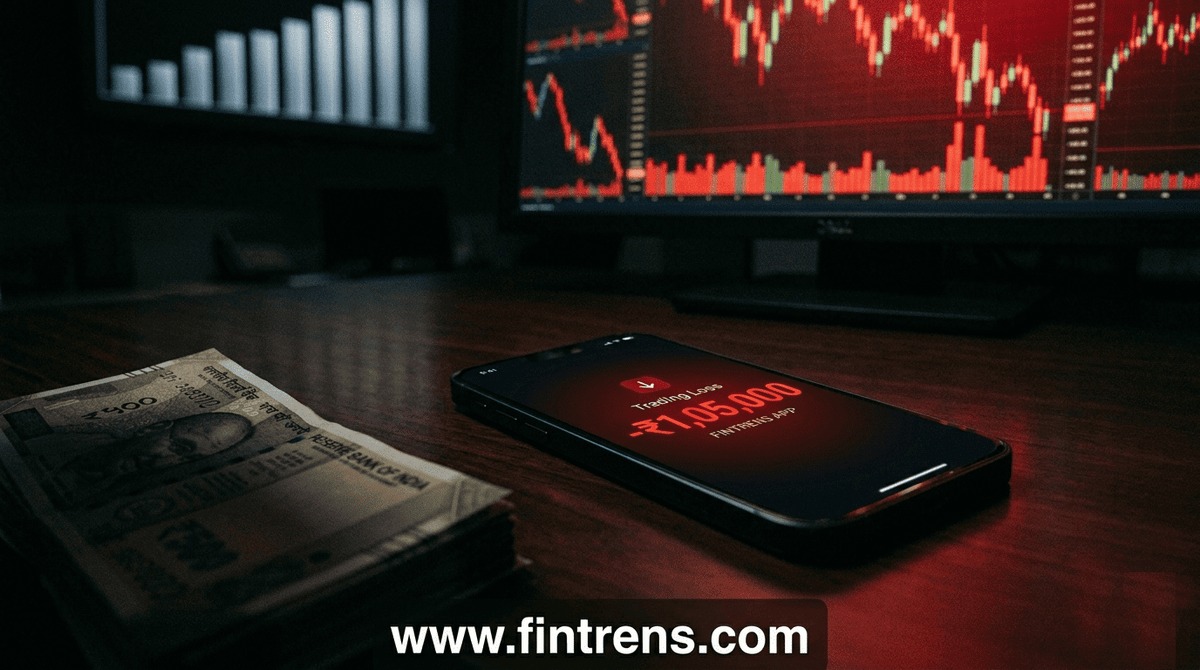
SEBI has the numbers. The apps keep sending the notifications. And someone is profiting from every single losing trade — just not you.
Let us start with the numbers, because they are staggering.
In FY2024–25, individual traders in India's futures and options (F&O) market collectively lost ₹1.05 lakh crore. That is roughly the GDP of a small Indian state, wiped out in 12 months by retail traders on their phones.
SEBI's own study found that 91% of individual F&O traders lost money in FY25. The average loss per trader: approximately ₹1.1 lakh.
Over the three years from FY22 to FY25, cumulative losses for individual F&O traders crossed ₹2.88 lakh crore.
Despite these numbers — which SEBI published, which the government confirmed, which multiple news organisations reported — the number of retail F&O traders in India has grown by over 120% in three years. Nearly 10 million Indians are now active in the F&O segment.
This is not a story about financial illiteracy. Most of these traders know the risks, at least in the abstract. This is a story about how a system was built — by exchanges, brokers, apps, and regulators acting in combination — that extracts money from retail participants with mathematical efficiency while maintaining the appearance of a fair market.
At Fintrens, this is the piece we have been building up to. Not a warning that "F&O is risky" — that is not news. But a clear-eyed look at exactly who profits from India's retail F&O boom, how the psychology is designed to keep traders coming back after losses, and what SEBI's recent crackdown actually achieved.
The Numbers Nobody Is Putting Together
SEBI's data tells a specific story. Let us be precise about what it actually says.
91% of individual traders in F&O lost money in FY25. This is not 91% of trades — it is 91% of individual traders, measured across the full year. Nine out of ten people who participated as retail traders finished the year poorer than they started.
The average net loss was ₹1.1 lakh per losing trader. This is not a rounding error or a small setback. For a trader earning ₹60,000–₹80,000 a month, this represents one to two months of gross salary — lost in options premiums and margin calls.
The 9% who made profits did not, on average, make much. A significant proportion of the "profitable" traders — those in the top decile by returns — are high-frequency algorithmic traders and proprietary desks, not retail individuals. The retail share of the profitable 9% is considerably smaller than it appears.
Net losses widened by 41% in FY25 compared to the prior year. As SEBI tightened rules and reduced the number of weekly option expiries — ostensibly to protect retail traders — losses per trader grew, not shrank. Retail traders simply concentrated their activity on the remaining expiries.
The total loss number of ₹2.88 lakh crore over three years does not include transaction costs — the STT (Securities Transaction Tax), exchange charges, brokerage, and GST paid on every trade. These costs are borne regardless of whether the trade makes money. Across 10 million active traders, these costs add tens of thousands of crore rupees more annually on top of the net P&L losses.
So: 91% lose. The average loss is ₹1.1 lakh. Transaction costs add further. The losing 91% grew by 120% in three years.
Something is working very well here. Just not for the traders.
Who Actually Profits from Every Losing Trade
This is the section that most Indian financial media avoids, because the answer implicates institutions that are also major advertisers, major sources of financial data, and in one case, the regulator itself.
The stock exchanges — NSE and BSE.
Every F&O trade, win or lose, generates transaction fees for the exchange. NSE earns per contract traded. In FY25, NSE's F&O segment generated billions in transaction income. The more trades retail traders make — regardless of outcome — the more NSE earns. NSE's revenue is directly correlated with retail F&O volume. When SEBI cut weekly expiries, NSE's revenue took a hit. NSE lobbied against the cuts.
This is not an allegation of wrongdoing. It is a structural conflict of interest that is rarely made explicit to new traders.
The brokers — Zerodha, Groww, Upstox, Angel One.
India's discount brokers have built enormous businesses on F&O trading. While many charge zero brokerage on delivery equity trades, they charge per-lot fees on F&O orders. Zerodha — India's largest broker by active clients — earns a significant portion of its revenue from derivatives trading.
More critically: the apps themselves are designed for engagement. Push notifications about market movements, real-time P&L dashboards, one-tap order execution, gamified referral programs, leaderboards — these are engagement mechanics borrowed from gaming and social media. They exist to keep traders active, which generates more orders, which generates more revenue for the broker.
When a retail trader makes ten trades and loses ₹50,000, the broker has earned on all ten trades. The broker's revenue is not contingent on the trader's profit.
The government — via STT and capital gains tax.
Securities Transaction Tax (STT) is levied on every F&O trade. The government collected approximately ₹40,000 crore in STT in FY25 — a record — driven substantially by retail F&O volumes. Profitable traders additionally pay tax on gains. Losing traders pay STT on their way down.
The government, in other words, collects tax on the gross trading activity of retail investors who are, on net, losing money. This creates a structural incentive at the policy level to maintain — or at least not aggressively eliminate — the retail F&O market.
The algorithm traders and proprietary desks.
F&O markets are zero-sum in their net payoff structure. For every rupee a retail trader loses on an options position, someone on the other side of that trade profits. In India's derivatives markets, the consistent winners are high-frequency trading firms and proprietary desks with algorithms, co-location servers, and microsecond execution speeds.
Retail traders consistently provide liquidity — and losses — to these counterparties. This is not manipulation. It is a structural information and speed asymmetry that is essentially impossible for retail participants to overcome.
How the Psychology Is Designed to Keep You Coming Back
If 91% of traders lose money, why do millions keep opening accounts?
The answer is not stupidity. It is behavioural economics applied with precision — some deliberately, some as an emergent property of how these markets work.
The near-miss effect.
Options trading regularly produces situations where a trader was one day, one expiry, or one price move away from a significant profit. "I was right about the direction but the timing was off." This near-miss experience is psychologically similar to gambling — it does not register as a loss the way a binary outcome would. It registers as "almost." Almost is enough to generate another trade.
Variable reward schedules.
The most addictive reinforcement structure in psychology is a variable ratio reward schedule — the unpredictability of a slot machine. F&O trading is structurally similar. Most trades lose. Occasional trades produce significant profits. The unpredictability of when the big win comes is what maintains the behaviour. Casino designers know this. F&O markets produce it naturally.
Loss aversion and averaging down.
Retail traders who are losing consistently tend to average down — adding more capital to a losing position in the belief that the market will reverse. This is the opposite of how professional risk managers behave. It converts small, manageable losses into catastrophic ones. And it is driven by the same loss aversion wiring that makes humans bad at probabilistic thinking generally.
The P&L dashboard.
Real-time profit and loss visibility is presented as a feature of trading apps. It is also a psychological tool. Watching your unrealised P&L fluctuate in real time creates an emotional relationship with positions that is antithetical to rational decision-making. Traders hold losing positions too long (hoping for recovery) and exit winning positions too early (locking in the dopamine hit of a green number). Both behaviours reduce returns.
Social media and trading communities.
The Telegram channels, the Twitter/X trading handles, the YouTube "options strategy" videos — these form an ecosystem that simultaneously normalises F&O trading and creates social proof. Every visible success story in a trading community is amplified. Losses are private. The visible evidence is survival bias in its most concentrated form: the 9% who made money, talking loudly, to the 91% who keep trying to join them.
What SEBI's Crackdown Actually Achieved
SEBI did act on its own data. Since October 2024, the regulator introduced a series of restrictions on the F&O segment: a reduction in weekly option expiries (from five days a week to typically one per exchange), higher contract sizes, upfront collection of option premiums, tighter position limits.
The stated goal was to reduce speculative retail participation and protect small traders.
The outcome: in Q3 FY26, the Average Daily Trading Value (ADTV) in F&O rose by 23% — the fastest expansion in seven quarters.
Retail participation did not fall. It accelerated. With fewer weekly expiries available, traders concentrated their activity more intensely on the remaining ones. Position sizes relative to capital grew. Losses per participant grew.
This outcome should not be entirely surprising. SEBI's measures addressed the supply of trading opportunities — the number of available expiries and contract sizes. They did not address the demand side: the psychology, the app design, the broker incentive structure, or the social ecosystem that generates and sustains retail F&O participation.
Reducing the number of casino games available does not reduce gambling addiction. It concentrates it.
Who Is Actually Entering F&O in 2026
The profile of the new retail F&O trader in India has shifted significantly since 2020.
The first wave of retail F&O participants were largely urban, financially literate traders who moved from equity delivery trading to derivatives — often experienced investors testing more sophisticated strategies.
The current wave is different. A significant proportion of new F&O accounts in 2024–2026 are from Tier 2 and Tier 3 cities — young men between 22 and 35 who downloaded Zerodha or Groww for equity investing and then moved into F&O after seeing YouTube videos or Telegram tips. Their capital base is smaller. Their financial cushion is thinner. Their experience with markets is more limited.
For these traders, a ₹1.1 lakh average loss is not an expensive lesson. It is a financial setback that can affect their savings trajectory for years. In some documented cases, it involves borrowing — using personal loans or credit card advances to fund F&O margin requirements. Losing borrowed money in options is a path directly into the debt trap.
The Five Signals That You Are Trading F&O the Wrong Way
This is not a section that tells you F&O is always wrong. Professional options strategies — covered calls, protective puts, structured hedging for portfolio risk management — are legitimate tools used by institutional investors worldwide.
But for the vast majority of retail Indians trading F&O through a phone app, the following signals indicate that the activity is costing money without a sustainable edge:
1. You are trading on tips from Telegram channels, social media, or YouTube traders. No legitimate trading edge comes from a Telegram channel. If someone has a consistently profitable options strategy, they use it themselves — they do not share it in a free group. Tips channels are lead-generation tools for brokers, SEBI-registered investment advisors charging fees, or outright fraudsters.
2. You are averaging down on losing positions. If your response to a losing F&O position is to add more capital to it, you are not managing risk — you are gambling on a reversal. Professionals cut losses. They do not double them.
3. You have not calculated your total transaction costs over the last 12 months. Add up every rupee paid in STT, exchange charges, brokerage, and GST on your F&O trades. This number is your guaranteed cost of participation, regardless of your P&L. Most retail traders who do this calculation are surprised by how large it is — and how much of their gross profit is consumed by it.
4. You are trading with money you cannot afford to lose. Options can expire worthless in hours. Margin calls can demand capital overnight. If the money in your trading account is your emergency fund, your rent deposit, or borrowed capital, you are not in a position to absorb the routine variance of options trading. You need to stop before the variance finds you.
5. Your account balance is lower than it was 12 months ago despite being "active." This is the simplest test. If you have been trading F&O for a year or more and your account is worth less today than it was when you started — adjusting for withdrawals — the activity is not generating returns. Persistence is not a virtue in a negative-expectation game.
What to Do With the Money Instead
This is not a prescriptive list. But for a salaried Indian in their 20s or 30s who has been putting ₹5,000–₹20,000 a month into F&O positions, the counterfactual is worth considering.
₹10,000/month invested in a Nifty 50 index SIP for 20 years, at a conservative 12% annualised return, becomes approximately ₹98 lakh.
₹10,000/month lost in F&O for 20 years — plus transaction costs — is ₹24 lakh gone, plus the opportunity cost of what it could have become.
The wealth gap between those two outcomes is not the result of intelligence. It is the result of where the money went and what it was allowed to do over time.
If you want market exposure with defined risk, structured products, multi-asset mutual funds, or equity index investing are routes that do not require predicting short-term price movements with precision to generate returns.
If you want to trade actively and understand that it is closer to a skilled hobby than a reliable income source — set a maximum drawdown limit before you start. When you hit it, stop. Treat it as the cost of the activity, not a debt to recover.
The Fintrens Checklist: Before Your Next F&O Trade
- Calculate your net P&L for the last 12 months — total profits minus total losses. Not this week, not this month. 12 months.
- Add every transaction cost — STT, exchange fees, brokerage, GST — to that calculation. Subtract it from any profit, or add it to any loss. This is your true cost of participation.
- Ask where your trade ideas come from. If the answer is a Telegram channel, a YouTube video, or a social media handle — that is not an edge. That is entertainment.
- Set a maximum capital allocation for F&O and treat it as entertainment budget, not investment capital. When it is gone, it is gone. It does not get refilled from your SIP, your emergency fund, or a personal loan.
- Never average down on a losing options position. Cut losses at a pre-set threshold. This is the single behavioural change that separates survivors from those who lose everything.
- Compare your F&O P&L to a simple Nifty 50 index SIP of the same capital. If the SIP would have outperformed you over the same period — and for 91% of traders it would have — you have the data you need to make a different decision.
- Read SEBI's study yourself. It is public. It is free. It names the numbers that the apps and the brokers do not mention when they send you the "Markets are volatile — great time to trade!" notification.
₹1.05 lakh crore lost. 91% losing. 120% growth in participants. SEBI's crackdown producing higher losses per trader.
The system is working perfectly. Just not for you.
At Fintrens, we are going to keep saying that — clearly, with data, and without the conflict of interest that shapes how most Indian financial platforms talk about derivatives trading.
For independent, unsponsored coverage of how India's financial markets and products actually work — follow Fintrens at blogs.fintrens.com