
Nvidia fell 48% from its October high, then rose 31% in a day. Here is where one rule was: out since June, and wrong for three months
Two Buy signals in two years, the second stopped out in June at $191.96 before a run to $239 and a fall to $125: Firefly's weekly breakout rule on Nvidia through the week its CEO left and came back.
Nvidia closed at $239.24 on 6 October, its highest ever. On Friday 20 November it closed at $125.53, 48 percent lower, after losing 14 percent in one session. On Monday the board brought Jensen Huang back as chief executive, eleven days after he had resigned, and the stock rose 31 percent in a day, its largest gain since 2003. On Tuesday it gave back 6 percent and closed at $155.38. In between came an earnings report that beat on every line and was sold anyway. This post is not about any of that. It is about where one fixed rule was while it happened, which is a shorter story: out, since June.
Firefly's weekly breakout rule, the one every page on Fintrens Signals reports, buys on a break above a recent high, checked weekly, with a stop under every entry. Its full record on Nvidia from 1 October 2024 is two rows.
Two rows, two years
| # | Buy signal | Entry | Exit | At | Days | Ended on | The stock three months after the exit |
|---|---|---|---|---|---|---|---|
| 1 | 29 May 2025 | $143.12 | 27 Mar 2026 | $169.60 | 302 | Trend reversal | $194.97 (29 Jun 2026, higher) |
| 2 | 7 May 2026 | $213.70 | 25 Jun 2026 | $191.96 | 49 | Stop | $224.58 (24 Sep 2026, higher) |
Prices are daily closes from the backtest's price file and the exchange. "Three months after" is the close 63 trading days after the exit, against the exit price.
The first row is the kind a breakout rule is for. It bought on 29 May 2025 at $143.12, on a break above the $143.05 level set in March, and stayed in for 302 days while the stock went to $207.04 and came back, leaving on 27 March 2026 at $169.60 when a reversal candle fired. Three months after that exit the stock was $194.97, higher. The exit looked early.
The second row is the kind people remember. It bought again on 7 May 2026 at $213.70, on a break above $197.16, and was stopped out 49 days later at $191.96. Three months after that stop the stock was $224.58, 17 percent above the exit, and on 6 October it was $239.24. For three months and a week the June stop was the wrong call by any measure a reader would use, and on Signals the Nvidia page said Wait through the whole run to the record. It said Wait because the batch ends on 30 September and the rule had no new signal to show, not because it saw anything.
What the rule was out for
Everything. On 12 November Huang resigned and the stock closed at $166.19, down 4.3 percent. On 17 November Nvidia reported third-quarter revenue of $115.8 billion against the $109.1 billion expected and guided the next quarter to $130 billion; the stock fell the next day and the day after. On Friday 20 November it closed at $125.53, down 14 percent on the day and 48 percent from the October high, the lowest close in a year, and 12 percent below the price the rule had first bought it at eighteen months earlier. On Monday 23 November the board reinstated Huang and the stock closed at $165.05, up 31.5 percent. On Tuesday, $155.38.
Through all of it the rule was where it had been since 25 June: out, at $191.96. Tuesday's close is 19 percent below that stop. Friday's was 35 percent below it. The same exit that looked wrong for three months, and looked worse on the day the stock made its high, is the reason the rule has nothing on this page from the fall.
It is worth being exact about what that is and is not. The rule did not see the resignation coming, or the earnings reaction, or the reinstatement. It reads one thing, the daily close, and a chief executive is not in it. It was stopped out in June because the stock fell about ten percent from an entry, which is what a stop is for, and the stop took it out of a run that went on for another 25 percent without it. A rule that only reads price cannot be early to a story. It also cannot be wrong about one. The cost and the benefit are the same mechanism, and this one stock has shown both sides of it inside five months.
What a 31 percent day is to a breakout rule
Nothing, on its own. The rule buys a break above a recent high. Nvidia's recent high is $239.24, and Monday's close, after its largest one-day gain since 2003, was $165.05, 31 percent below it. A stock that has halved and then bounced is, to this rule, a stock a long way under its high, and the rule has no setting for a comeback story. If the next batch, which reads October and November, finds a signal on Nvidia, that row goes on the page with its date and its price. If it finds none, the page keeps saying Wait, and that is also an answer.
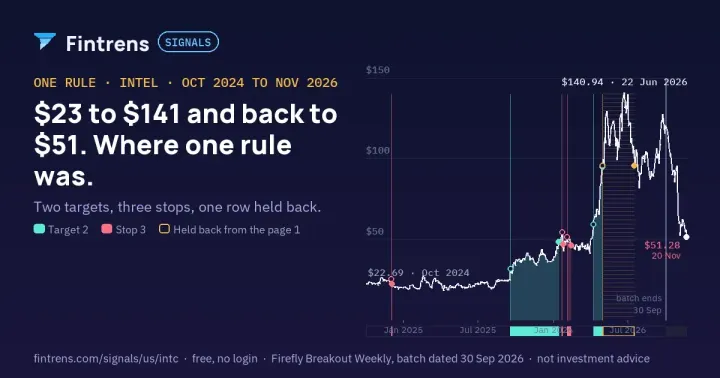
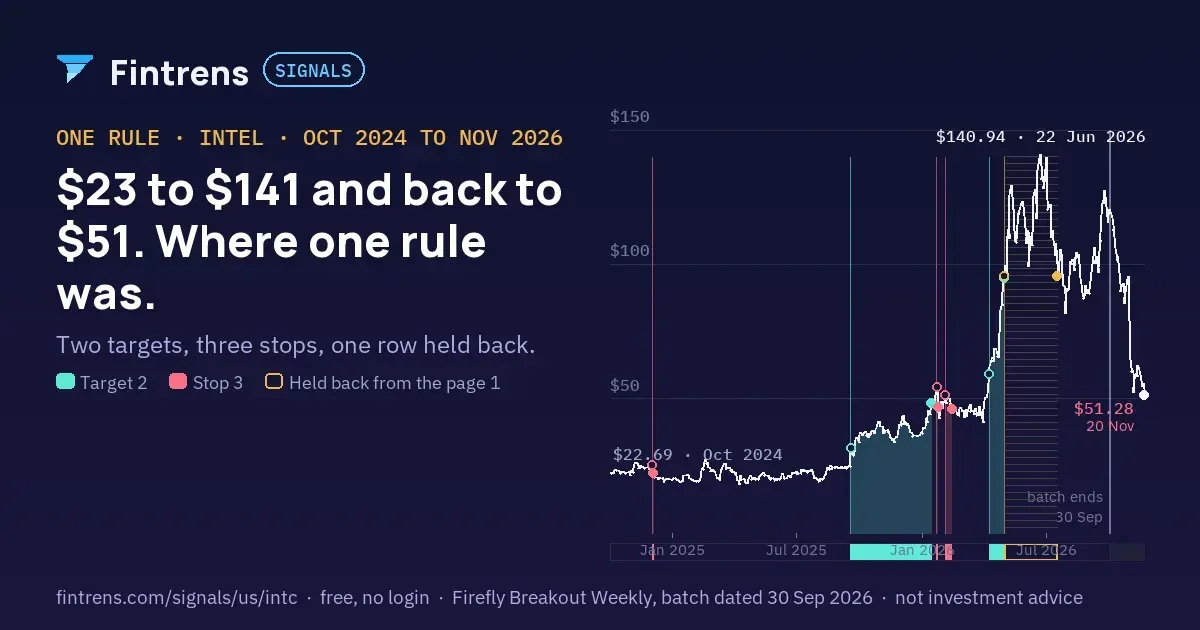
Yesterday's post was about Intel, where the same rule left in July at $95 and the stock then rose a quarter before falling 64 percent. Nvidia is the same shape a size larger: out in June at $191.96, a run of 25 percent without it, then a fall that took the stock under the rule's first entry. On both pages the exit looked early for three months. On both the rule did not change its mind, because it has no mind to change.
Further reading
- Nvidia on Fintrens Signals: both signals, with dates and prices, and the Wait.
- Intel, two years, one rule: yesterday's post, the same exit on a different stock.
- Every US stock the rule tracks, free, no login.
Sources for the stock's moves: CNBC, 12 November; CNBC, 18 November; 24/7 Wall St., 21 November; Yahoo Finance, 24 November. Closes from Yahoo Finance.
Past signals do not predict future prices. The outcomes above are simulated by applying one rule to historical daily prices, before costs; nobody traded them. Educational information, not investment advice. Fintrens is a software company, not a SEBI-registered investment adviser.