
Oil at $118. ₹12 Lakh Crore Wiped Out Overnight. The Storm Has Already Arrived — Is India Ready?
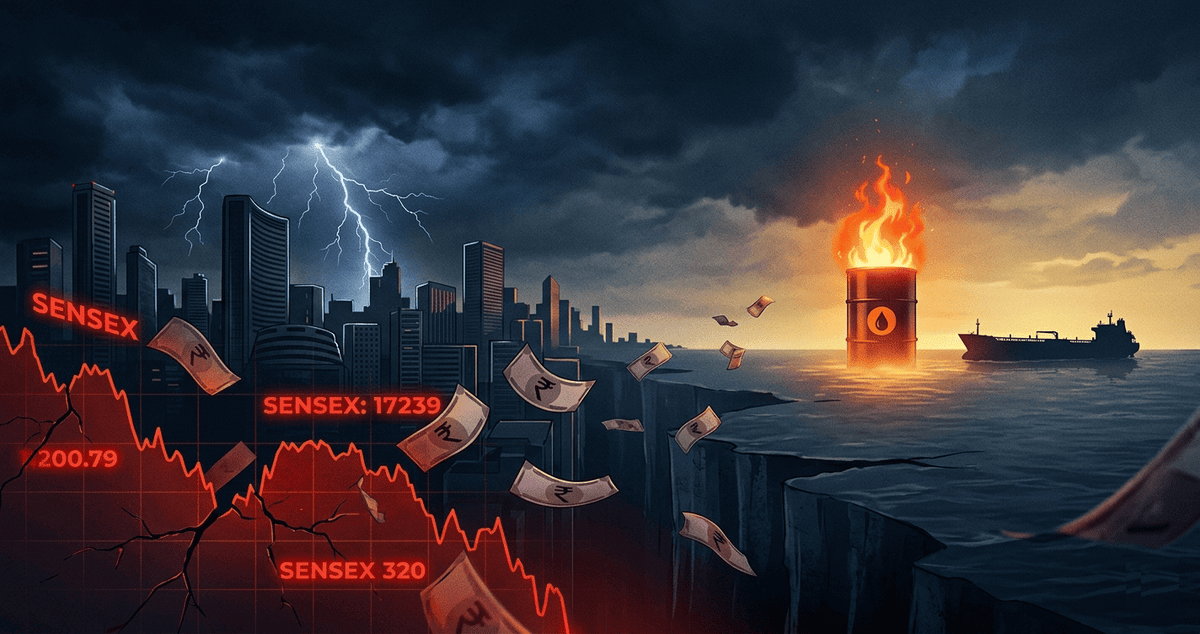
On a single day in early April 2026, Indian investors watched helplessly as over ₹12 lakh crore of wealth evaporated from Dalal Street in one session. Sensex and Nifty plunged more than 5%. Not in a week. Not gradually. In a single day.
Most headlines moved on by the next morning.
They shouldn't have. Because that day wasn't an anomaly. It was a signal — and the signal says something much larger is unfolding.
We are living through one of the most dangerous intersections of global crises in recent memory: a Middle East war threatening the world's most critical oil corridor, crude prices surging past levels India hasn't dealt with in years, a US-China trade war spilling over into tariffs on Indian exports, and a global economy that the IMF has bluntly titled its April 2026 report on: "Global Economy in the Shadow of War."
The storm isn't on the horizon. It's already here. The question is whether you're prepared for it — or whether you're still waiting to see how bad it gets before you act.
How a War 3,000 Kilometres Away Is Already Changing Life in India
Here is the chain reaction most people don't fully see:
The conflict in the Middle East has put the Strait of Hormuz — a narrow channel through which nearly 20% of the world's oil supply flows — under serious threat. For India, that's not just a geopolitical headline. It's a direct economic vulnerability.
India imports 85% of its crude oil requirements. Roughly half of that crude transits through the Hormuz Strait. When that corridor is disrupted, India doesn't just pay more for petrol and diesel. The entire economy pays more for everything.
Brent crude has already surged nearly 29%, breaching $118 per barrel in recent months. For context: every $10 rise in crude prices widens India's current account deficit by 40–50 basis points and adds $13–14 billion to the nation's annual import bill. Global brokerage Bernstein has issued a stark warning, suggesting that if energy costs stay elevated, India could face a "Global Financial Crisis moment."
The rupee weakens. Imports become more expensive. Inflation rises. The RBI faces a brutal choice between fighting inflation and protecting growth. Neither option is painless.
This is not theory. This is already happening.
The Trade War Nobody Expected India to Get Caught In
While the Middle East dominates the news, another crisis has been quietly building on a different front.
The US, in a sweeping move, slapped 26% reciprocal tariffs on Indian exports — hitting sectors from pharmaceuticals and textiles to engineering goods. An interim deal in February 2026 brought effective tariffs down to 18%, but the framework remains legally incomplete and could unravel at any point.
The IMF estimates this trade disruption will shave 0.3–0.4% off India's GDP. That may sound modest in percentage terms, but in a ₹300+ lakh crore economy, that's lakhs of crore in lost output — and hundreds of thousands of jobs in export-dependent sectors hanging by a thread.
India had positioned itself as the beneficiary of global supply chains moving away from China. That opportunity is real — but so is the turbulence that comes with being more integrated into a world that is increasingly divided.
What the Numbers Are Telling Us Right Now
Let's put it all together:
- Global growth is slowing to 3.1% in 2026 — the IMF's Spring 2026 forecast, down from earlier projections
- India's GDP growth is expected to ease to 6.1% in FY27, according to OECD, down from 7.4% this fiscal year — as energy costs, trade disruption, and fading fiscal support bite
- Crude at $118/barrel is adding billions to India's import bill every month
- ₹12 lakh crore was wiped from Indian market capitalisation in a single session
- US tariffs at 18–26% on Indian goods remain a live, unresolved threat
This is a country running hard into a headwind it didn't fully anticipate — and the headwind is getting stronger, not weaker.
So What Does This Actually Mean for the Ground Level?
Here's where macro meets real life.
When oil prices rise, India's import bill balloons. To fund that, the government either borrows more — crowding out private investment — or cuts spending elsewhere. Either way, infrastructure slows, corporate margins compress, and job creation weakens. When the rupee falls alongside rising oil, imports of everything from electronics to edible oil become more expensive. Inflation hits the most ordinary items first: fuel, cooking gas, transport, food.
When global growth slows, Indian exports — IT services, pharma, textiles, engineering — face headwinds. Companies review hiring plans. Increments get conservative. Bonuses shrink. Sectors that were expanding quietly start consolidating.
And when the stock market corrects sharply, household wealth erodes — for those who have investments — and consumer sentiment drops for everyone. People spend less. Businesses earn less. The cycle feeds itself.
None of this is catastrophic in isolation. Together, it adds up to an environment where the buffer between stability and stress is much thinner than it was a year ago.
What You Can Do About It — Practically, Right Now
The good news: the same forces that create macro risk also create macro opportunity — for those who are positioned for it.
1. Rethink Where Your Idle Money Sits
With inflation creeping up and rupee under pressure, money sitting in a savings account earning 3–4% is quietly losing value in real terms. Move idle cash into liquid mutual funds or short-duration debt funds — better returns, same liquidity. If you have a long horizon, gold has historically been a strong hedge during exactly this kind of geopolitical and currency stress.
2. Relook at Your Equity Exposure — But Don't Exit
Volatility is not a reason to leave the market. It's a reason to be smarter about how you're in it. If your equity portfolio is concentrated in rate-sensitive or import-dependent sectors (auto, FMCG, aviation, consumer discretionary), consider rebalancing toward sectors that benefit from or are insulated against high oil: energy, defence, pharma, IT (export earners who benefit from a weaker rupee).
Don't stop SIPs. Downturns are precisely when SIPs build the most wealth — you're buying more units for the same money.
3. Hedge Your Life Against Inflation
This is not just about investments. Look at your monthly expenses and identify the big-ticket items that will get significantly more expensive as oil stays elevated: fuel, cooking gas, flights, anything imported. Where possible, front-load major purchases or lock in fixed-rate agreements before costs rise further.
If you're planning a foreign trip, the rupee weakening means it gets more expensive every month you delay.
4. Keep 6–12 Months of Essential Expenses Liquid and Accessible
Not invested. Not locked in. Liquid. In an environment where corporate earnings are under pressure and global demand is softening, employment security is lower than it appears on the surface — even for people who feel safe today. A cash buffer buys you time and options. Without it, a disruption becomes a crisis.
5. Pay Attention to Crude as a Leading Indicator
Most people track Sensex and Nifty. Start also tracking Brent crude. In India's economy, crude prices are arguably the single most powerful external variable — they affect inflation, the rupee, fiscal math, consumer spending, and corporate margins simultaneously. When crude crosses key levels — watch for RBI commentary, Government responses, and sector impacts. That's where the real early signals live.
The Bigger Picture
India is not in recession. Let's be clear about that. With GDP projected at 6.1–7.4% depending on how the second half of the year plays out, India remains one of the fastest-growing major economies on the planet.
But growth does not mean immunity. And "fastest growing" does not mean "untouched by global forces."
The 2026 story is about a world that has become more fragile than most people priced in — wars, trade conflicts, energy shocks, and slowing global demand all arriving at once. India is deeply connected to that world: through oil dependency, export revenues, FII flows, and global sentiment.
The people who will navigate this period well are not those who panic — they're the ones who understood the environment clearly, positioned themselves intelligently, and kept their heads when headlines were screaming.
That starts with knowing what's actually happening. And now you do.
Fintrens tracks the global and Indian economic trends that shape your financial reality — and translates them into clear, grounded analysis you can actually use. Follow us for weekly breakdowns of what the big macro moves mean for you.
Sources: IMF World Economic Outlook April 2026 — "Global Economy in the Shadow of War" | Bernstein Research — India Energy Shock Warning | OECD India GDP Forecast FY27 | BusinessToday — West Asia Crisis & Budget Math | Multibagg — ₹12 Lakh Crore Market Crash | MUFG Research — Strait of Hormuz & INR | ORF — Tariffs, Oil and the Rupee: India's External Reckoning