
Why Most Fintech Apps Are Secretly Bad for Your Money (And What to Use Instead)
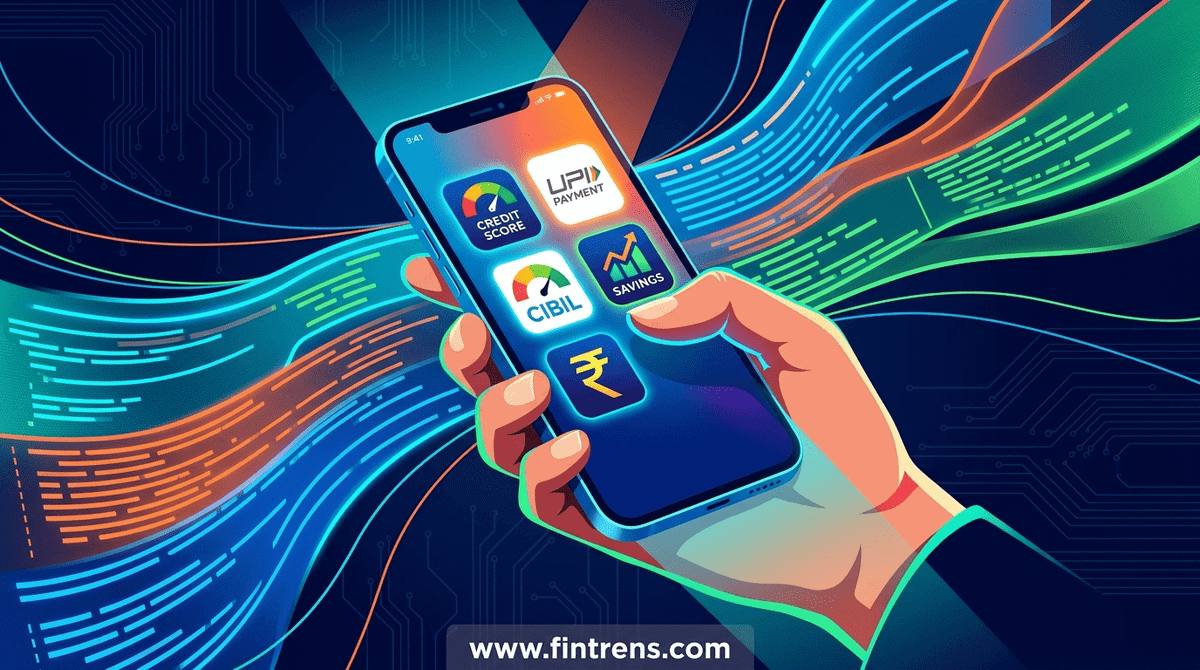
You downloaded the app. You set up the budget categories. You linked your accounts and watched the colourful pie charts fill up with your spending data.
And then — nothing changed.
If that sounds familiar, you are not alone. India now has over 500 million active fintech app users — one of the largest in the world. UPI has crossed 18 billion transactions a month. There are apps to budget, apps to invest, apps to track spending, apps to build credit, apps that do all of the above with a cheerful mascot and daily push notifications.
Yet household savings rates in India have been declining for over a decade. Personal loan disbursals are at an all-time high. Credit card debt among urban millennials has more than doubled since 2020. And financial anxiety — in a country where money stress has always been real — is not getting better.
So here is the uncomfortable question nobody in the Indian fintech industry wants to ask: what if the apps themselves are part of the problem?
At Fintrens, we have spent the last year studying how people actually use personal finance apps — not how the apps say people use them. What we found should make every founder, investor, and user in the Indian fintech space stop and think.
The Illusion of Control
The most popular fintech apps share a single design philosophy: make the user feel in control without actually giving them control.
Open any budgeting app today. You will be greeted with a clean dashboard, beautiful graphs, and a satisfying sense of overview. Your rent is categorised. Your Swiggy spending is flagged. A cheerful notification tells you that you are "on track" this month.
But here is what those dashboards are not telling you:
Visibility is not action. Knowing you spent ₹8,500 on food delivery last month does not automatically mean you will spend less this month. Behavioural economics has known this for decades. Simply presenting data to people does not change behaviour — it only changes how informed they feel about their existing behaviour.
A 2024 study on fintech adoption in emerging markets found that users of budgeting apps reported feeling significantly more financially confident than non-users, yet showed no statistically significant improvement in actual savings rates or debt reduction over a 12-month period. The apps were producing confidence without outcomes.
That gap — between how financially capable people feel and how financially capable they actually are — is dangerous. It creates a false sense of security that can actively discourage the harder work of actually changing spending habits.
For the average Indian salaried professional earning ₹50,000–₹80,000 a month, this false sense of security is not a minor inconvenience. It is the difference between building a meaningful emergency fund and remaining one medical bill away from a personal financial crisis.
The Business Model Problem
To understand why most fintech apps are not truly built to help you save money, you need to understand how they make money.
The free budgeting app you downloaded did not build itself. It has a team of engineers, designers, data scientists, and growth marketers. In India's startup ecosystem, that typically means crores of rupees in monthly burn. The app has investors expecting returns. So how does a free app afford it all?
There are three common answers, and none of them are fully aligned with your financial wellbeing.
1. Selling your financial data. Anonymised or aggregated spending data is extraordinarily valuable to banks, NBFCs, insurers, and advertisers. When you link your accounts and let an app categorise your spending — your EMI payments, your Zomato orders, your petrol bills — you are generating a highly detailed picture of your financial behaviour. In India, where Account Aggregator frameworks are now making this data even more portable, that picture has a very real market value. You are not the customer. You are the product.
2. Upselling financial products for a commission. The moment your app flags that you have a high-interest personal loan or a low savings rate, it has a commercial opportunity. Most apps use that moment to recommend a partner product — a credit card, a home loan, a mutual fund, a buy-now-pay-later scheme — for which they receive a referral fee or distribution commission. The recommendation may genuinely be useful to you. Or it may simply be the highest-paying option for the app. You have no easy way to tell the difference. And in India, where financial literacy is still unevenly distributed, millions of users trust these recommendations as if they were independent advice.
3. Premium subscriptions that most users do not actually need. Many apps offer a free tier that is deliberately limited, nudging users toward a paid plan of ₹199 or ₹499 a month. The features behind the paywall are often things that should simply be standard — better analytics, investment tracking, tax-saving suggestions. Users end up paying a subscription fee for functionality that serves the app's business model more than it actually solves their financial problems.
None of this means every Indian fintech app is acting maliciously. But it does mean that the interests of the app and the interests of the user are frequently not aligned. An app that genuinely helped you become financially independent — spending less, saving more, building real wealth — would be an app slowly working against its own revenue model.
The Gamification Trap
Fintech apps in India have borrowed heavily from the playbook of social media and gaming. Streaks, points, cashback rewards, scratch cards, badges, and "milestone" notifications are everywhere. The logic is straightforward: if you can make financial management feel like a game, people will engage more.
The problem is that gamification optimises for engagement, not outcomes.
When an app rewards you with coins for logging your spending every day, it is not rewarding you for spending less — it is rewarding you for opening the app. These are very different things. An app that has successfully gamified daily check-ins has a highly engaged user base that generates data, ad impressions, and subscription revenue. Whether those users are actually building wealth is a secondary concern at best.
There is also a subtler psychological trap at play. Research on "goal substitution" suggests that when people engage in activities that feel productive — like organising a budget on an app or categorising expenses into neat folders — they often feel less compelled to take the harder real-world actions those activities are supposed to lead to. The act of budgeting becomes a substitute for the financial discipline that budgeting is meant to build.
Think about it honestly: how many hours have you spent colour-coding expense categories on an app while your SIP has been paused for three months?
The Personalisation Gap
Indian fintech apps tend to treat users as data points rather than as people with genuinely different lives.
A 24-year-old IT fresher in Pune earning ₹4.5 lakh a year, repaying an education loan and sending money home to parents, has an almost entirely different financial situation from a 38-year-old business owner in Ahmedabad managing GST compliance, irregular income, and two children's school fees. Yet most apps offer them both the same generic budget categories, the same savings nudges, and the same investment recommendations.
True personalisation in personal finance requires understanding your situation in context — your income trajectory, your family obligations, your tax slab, your risk tolerance, your goals, your city's cost of living. In India, it also requires understanding the nuances of the joint family system, regional financial customs, agricultural income cycles for rural users, and the reality that a large portion of transactions still happen in cash.
Most apps are not equipped to handle any of this complexity. They are not regulated to give personalised financial advice. And building genuine guidance at scale is extremely hard. So instead they offer the appearance of personalisation — your name on the dashboard, categories inferred from your UPI transactions — while the underlying logic remains largely one-size-fits-all.
The Five Data Traps Hidden in Plain Sight
This is the section most fintech apps hope you never read.
Beyond the general business model problem, there are five very specific features — features that look like they exist to help you — that are actually sophisticated data collection mechanisms dressed up as financial wellness tools. Each one is worth understanding in detail.
Trap 1: The "Free CIBIL Score" with Monthly Refresh Reminders
Dozens of Indian apps now offer free CIBIL score checks. On the surface, this sounds like a genuine public service — and knowing your credit score is genuinely useful.
But look closely at what happens after you check your score.
The app now has your full credit report: every credit card you hold, every loan you have ever taken, every EMI you are currently paying, and — crucially — every credit enquiry that has been made on your name. This is an extraordinarily detailed map of your financial life. The app knows your outstanding balances, your repayment behaviour, your credit utilisation ratio, and which lenders have already assessed your creditworthiness.
Then the gamification begins. Badges for "monitoring your score." Nudges to "refresh your score" every month. Notifications that your score "may have changed." The goal is not to improve your credit health — the goal is to keep you checking, because every check refreshes your data and keeps your credit profile current in their system.
What they do with that data: they build a precise lending risk profile on you and sell access to banks, NBFCs, and digital lenders who are willing to pay for warm, pre-qualified leads. When that same app then recommends you a credit card or a personal loan with "pre-approved" offers, it is not coincidence — it is the business model completing its loop. The app earns a distribution commission from the lender. You become the product that was sold.
Trap 2: Adding Your Vehicle Details for "Insurance Reminders"
Several fintech and UPI apps now prompt you to add your vehicle registration number — ostensibly to remind you when your insurance or PUC certificate is due for renewal.
This is a genuinely useful-sounding feature. Who does not want a reminder before their car insurance lapses?
But your vehicle details — registration number, make, model, manufacturing year, city of registration — are highly valuable data for insurance companies. Combined with your location data (which most apps already have), your payment behaviour, and your income signals from your transaction history, your vehicle profile becomes part of a detailed risk assessment that insurers use to price policies and generate leads.
When that same app then shows you insurance renewal options, it is not showing you the market's best rates. It is showing you the rates from insurers who have paid for the lead. The app earns a commission from every policy sold. The "reminder" feature was always, at its core, an insurance distribution channel with a helpful wrapper.
Trap 3: Linking Your Credit Card for "Statement Tracking"
"Link your credit card to track your spending in one place" is one of the most common prompts in Indian personal finance apps. The pitch is consolidation and convenience — see all your expenses, HDFC and SBI and Axis, on a single dashboard.
What you are actually handing over is your complete spending personality.
Your credit card statements reveal not just how much you spend but where you spend it, when you spend it, what kind of person you are, and what financial products you are likely to be receptive to. A person who regularly spends at premium restaurants and travels frequently is a different credit and insurance risk profile from someone whose spending is dominated by grocery stores and utility bills. Advertisers, lenders, and insurers pay handsomely for that level of behavioural segmentation.
Beyond the data value, your statement also tells the app exactly which credit card products you currently hold — making it trivial to identify gaps. No travel card? Here is a co-branded recommendation. High utilisation on your existing card? Here is a balance transfer offer. Every recommendation comes with a commission. Your statement was the raw material.
Trap 4: UPI Handles — Tracking Payments Without Touching Your Bank Account
This one is perhaps the most underappreciated privacy issue in Indian fintech today.
Several apps encourage you to add or create a UPI handle within their platform — even apps that are not primarily payment apps. The pitch is convenience: make payments from within the app without switching to a separate UPI app.
But a UPI handle linked through a fintech app gives that app something very valuable: visibility into your payment metadata. Who you pay, how often, how much, and when. Even without direct access to your bank account, payment patterns tell a detailed story. Regular payments to a school suggest you have children of a certain age. Regular payments to a hospital suggest an ongoing health issue. Payments to a landlord rather than a housing society suggest you rent rather than own.
This metadata — not your account balance, just the pattern of who you pay and when — is used to build behavioural profiles that inform everything from loan eligibility assessments to targeted product recommendations.
Trap 5: The Balance Check That Reveals More Than You Think
Here is something almost nobody realises: when you check your bank account balance through a third-party fintech app using UPI, you are not simply viewing your balance privately.
The UPI balance enquiry goes through the fintech platform's infrastructure before it reaches your bank. This means the platform receives your current account balance at that exact moment. Over time — if you check regularly, as most users do — the app builds a longitudinal picture of your account balance history. It knows when your salary arrives. It knows how quickly you spend it. It knows your month-end balance patterns, which are a reliable proxy for how financially stressed you are.
This real-time balance visibility, accumulated over months, is extraordinarily valuable for credit risk assessment and product targeting. An app that knows your salary arrives on the 1st, drops 60% by the 10th, and bottoms out near zero by the 28th knows something very precise about your financial vulnerability — and about exactly when in the month you are most likely to respond to a personal loan offer.
None of this requires the app to have any formal access to your bank account. The balance check you do casually, multiple times a month, does the work for them.
If most fintech apps are not delivering on their promise, what does actually work?
The evidence consistently points to a few core principles.
Automation beats intention every time. The single most effective financial behaviour change is removing human decision-making from the equation entirely. Auto-debit SIPs on salary credit day, automatic recurring deposits, auto-pay for credit card bills — these work not because they make you more financially aware but because they make your financial awareness irrelevant to the outcome. The money moves before you even think about spending it. The RBI's auto-debit mandate framework has made this easier than ever in India. Use it.
Friction is your friend. Good financial design makes good decisions easy and poor decisions harder. The best tools are not the ones with the most features — they are the ones that quietly put obstacles between you and impulsive spending, while making investing as frictionless as possible. If your mutual fund app requires three clicks and a PIN to redeem but shows you a "spend now" UPI shortcut on the home screen, its design is working against your wealth.
Goals beat budgets. Research consistently shows that people are more motivated by specific, emotionally meaningful goals than by abstract budget categories. "Save ₹10 lakh for a flat down payment by March 2028" is a fundamentally more powerful motivator than "spend less on eating out." Apps that tie your savings to a concrete, visualised goal — a dream home, your child's education, early retirement — outperform apps that focus purely on tracking what you already spent.
Advice beats data. Data tells you what you did. Advice tells you what to do next. The most valuable thing a financial tool can offer is not a prettier spending chart but a clear, trustworthy answer to the question: "given my income, my loans, my family situation, and my goals — what should I do this month?" That requires either a qualified human advisor or genuinely sophisticated AI. It does not come from transaction categorisation alone.
The Apps That Are Getting It Right
To be fair, the Indian fintech landscape is evolving. A small number of platforms have genuinely built their model around user outcomes rather than just user engagement.
Platforms that lead with automated SIP investing — making it the default action rather than an afterthought — show measurably better wealth outcomes for users. Apps that integrate goal-based investing with tax planning (connecting your ₹1.5 lakh 80C limit to your actual investment shortfall, for example) offer real utility beyond dashboards. And a new wave of AI-powered financial assistants is beginning to offer something closer to genuine personalised guidance — analysing your full Account Aggregator data picture and giving context-aware, actionable recommendations rather than generic nudges.
The key question to ask of any fintech app is this: does this app make money when I actually build wealth, or does it make money regardless of my financial outcomes? If the answer is the latter, engage with it with open eyes.
What Fintrens Believes
At Fintrens, we think the Indian fintech industry is at a genuine inflection point.
The first wave of Indian fintech disruption — led by Jan Dhan accounts, UPI, and the explosion of mobile-first banking — was about access. Bringing hundreds of millions of previously unbanked Indians into the formal financial system was transformative work, and its impact cannot be overstated.
The second wave needs to be about outcomes. Not about monthly active users or transaction volumes — but about whether Indians who use these tools are measurably wealthier, more secure, and less financially stressed one year from now. Not about app store ratings. About real lives.
That requires a different business model. A different design philosophy. A different definition of success. It means building tools that are honest about what they can and cannot do, that treat users as people with real financial lives and real obligations — not as acquisition costs to be monetised.
It is harder to build. It is harder to monetise in the short term. But it is the only version of Indian fintech that deserves the extraordinary trust that hundreds of millions of people are placing in it.
What You Should Do Right Now
If you currently use a fintech app, run this practical audit before your next login:
- Check the business model first. How does this app actually make money? If it is free and the answer is not immediately obvious, your financial data is the product. Read the privacy policy — specifically the section on data sharing with third parties. It is uncomfortable reading. Do it anyway.
- Treat your CIBIL check as a one-time task, not a monthly ritual. Check your credit score once or twice a year through the official CIBIL website or your bank's portal. Every "free" monthly refresh on a third-party app is refreshing your data profile for their lending pipeline — not for your benefit.
- Do not add vehicle details to any app that is not your insurer or an RTO-linked service. If a payment app or budgeting app is asking for your registration number, it is building an insurance lead pipeline. Get your renewal reminders from your insurer directly.
- Link credit cards only to apps you genuinely trust — and understand what you are giving up. Your statement is a complete behavioural profile. If the app earns commissions from financial product recommendations, your statement data is a commercial asset to them, not just a convenience feature for you.
- Check your bank balance directly through your bank's own app or USSD. Avoid balance checks through third-party fintech apps. The ₹0 cost of convenience is paid in real-time balance visibility — handed over to a platform whose interests may not align with yours.
- Be sceptical of every product recommendation in every app. When an app recommends a credit card, a personal loan, or an insurance policy, search for the disclosure of commission or referral fee. Under SEBI and RBI guidelines, this must be disclosed. Find it before you act.
- Measure outcomes, not engagement. Has your net worth actually improved since you started using the app? Is your emergency fund larger? Is your SIP amount higher? If the honest answer is no, the app has been generating activity without generating progress.
India is building one of the world's most exciting fintech ecosystems. The infrastructure — UPI, Account Aggregator, DigiLocker, ONDC — is genuinely world-class. The ambition is real.
But ambition and infrastructure alone do not build household wealth. The apps sitting on top of that infrastructure need to be honest about whose interests they are truly serving.
The more Indians who ask that question out loud, the faster the industry will be forced to answer it properly.
At Fintrens, that is exactly the conversation we are committed to having.
Want honest, independent analysis of the Indian fintech tools that are genuinely worth your trust — and the ones that are not? Follow Fintrens.
If this made you think differently about an app you use every day, share it with someone who needs to hear it.