
Nifty IT fell 44% in nineteen months. One rule bought it ten times. Nine closed below entry, and it never bought TCS or Infosys
Ten Nifty IT stocks against one weekly breakout rule since October 2024: ten Buy signals, nine closed below entry, bought at the December 2024 top, silent since February 2026. It never bought TCS or Infosys, the two that fell most.
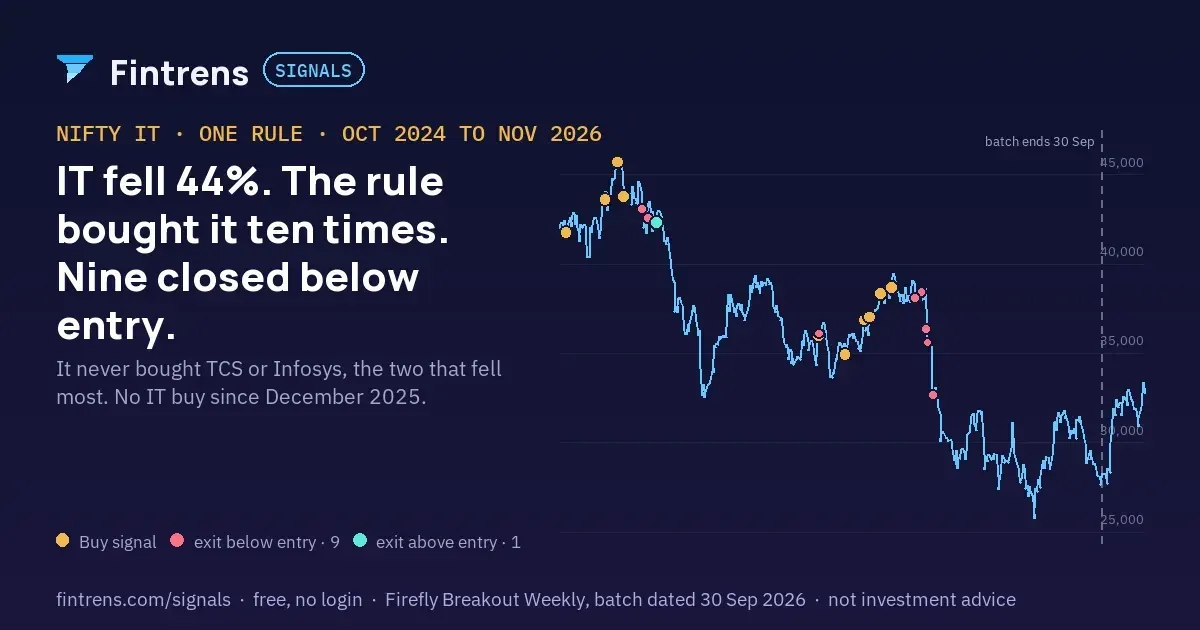
The Nifty IT index closed at 45,995.80 on 13 December 2024. On 1 July 2026 it closed at 25,769.80, 44% lower, nineteen months later. On Friday it closed at 32,758.10, 27% off that low, after the sector led the Nifty 50 for most of this week. TCS and Infosys are each about 40% below where they were in October 2024.
Fintrens Signals publishes what one of Firefly's rule-based strategies, Firefly Breakout Weekly, has done on every NSE stock since October 2024: every Buy signal, every exit, the losing ones included. This is that record for the ten stocks in the Nifty IT index, set against the fall and the rebound.
The short answer: in two years the rule gave ten Buy signals on seven of the ten names. Nine of the ten closed below their entry price and one above. Four ended at the stop, six on a trend reversal. Three names never got a signal at all: TCS, Infosys and Mphasis. TCS and Infosys are the two that fell most. The last IT Buy signal was on 19 December 2025 and the last exit on 13 February 2026; since then the rule has not bought an IT stock, through the fall to the July low and through the first part of the rebound, up to 30 September, where the current batch ends.
The ten, name by name
Every row links to the stock's Signals page, where the full record is. Entries and exits are the rule's simulated prices, before costs. "Friday vs last entry" is Friday's NSE close against the price of the last Buy signal, which is not a trade: it says only where the stock is now against the last place the rule got in.
| Stock | 1 Oct 2024 | Fri 27 Nov 2026 | Change | The rule's Buy signals since Oct 2024 | Friday vs last entry |
|---|---|---|---|---|---|
| Tata Consultancy Services | ₹4,287.90 | ₹2,572.50 | -40.0% | No Buy signal since Oct 2024 | — |
| Infosys | ₹1,904.35 | ₹1,151.30 | -39.5% | No Buy signal since Oct 2024 | — |
| LTIM * | ₹6,273.45 | ₹4,320.00 | -31.1% | Buy 17 Oct 2025 at ₹5,750.00; out 4 Feb 2026 at ₹5,581.00 (trend reversal, below entry) | -24.9% |
| Wipro | ₹273.38 | ₹192.10 | -29.7% | Buy 20 Dec 2024 at ₹320.00; out 14 Jan 2025 at ₹288.00 (stop, below entry) Buy 19 Dec 2025 at ₹267.00; out 20 Jan 2026 at ₹240.25 (stop, below entry) | -28.1% |
| HCL Technologies | ₹1,816.50 | ₹1,424.10 | -21.6% | Buy 12 Nov 2025 at ₹1,588.00; out 6 Feb 2026 at ₹1,578.50 (trend reversal, below entry) | -10.3% |
| Oracle Financial Services Software | ₹11,442.65 | ₹9,250.00 | -19.2% | Buy 11 Sep 2025 at ₹9,950.00; out 12 Sep 2025 at ₹8,953.00 (stop, below entry) | -7.0% |
| MphasiS | ₹3,015.60 | ₹2,441.20 | -19.0% | No Buy signal since Oct 2024 | — |
| Tech Mahindra | ₹1,625.40 | ₹1,813.90 | +11.6% | Buy 25 Nov 2024 at ₹1,767.80; out 3 Feb 2025 at ₹1,605.15 (trend reversal, below entry) Buy 4 Dec 2025 at ₹1,570.80; out 13 Feb 2026 at ₹1,482.60 (trend reversal, below entry) | +15.5% |
| Persistent Systems | ₹5,487.75 | ₹6,320.00 | +15.2% | Buy 12 Dec 2024 at ₹6,487.25; out 22 Jan 2025 at ₹5,749.00 (stop, below entry) Buy 19 Nov 2025 at ₹6,317.50; out 29 Jan 2026 at ₹6,012.50 (trend reversal, below entry) | +0.0% |
| Coforge | ₹1,425.29 | ₹2,071.00 | +45.3% | Buy 3 Oct 2024 at ₹1,439.60; out 3 Feb 2025 at ₹1,594.89 (trend reversal, above entry) | +43.9% |
* LTIMindtree now trades on the NSE as LTM; its Signals page is still under the old symbol. Prices since October 2024 are adjusted for Coforge's 2025 split. Index levels are NSE closes via Yahoo Finance; stock closes are the NSE close of 27 November.
Bought at the top, December 2024
The first three IT signals came within four weeks of the sector's high. Tech Mahindra on 25 November 2024 at ₹1,767.80, Persistent Systems on 12 December at ₹6,487.25, the day before the index peaked, and Wipro on 20 December at ₹320.00. A breakout rule buys a stock that clears its recent range, and in December 2024 these three had just done that. The index turned the next week. Wipro was stopped out at ₹288.00 on 14 January, Persistent at ₹5,749.00 on 22 January, and Tech Mahindra left on a trend reversal at ₹1,605.15 on 3 February 2025.
That is the cost of the design, stated plainly. A rule that buys strength will sometimes buy the last of it. What it does next is the part that matters: it put a stop beside each of the three, took the exits, and did not buy IT again for seven months, through the April 2025 low at 32,669. When it did, in September 2025, it was Oracle Financial Services Software on 11 September at ₹9,950.00, stopped out the next session at ₹8,953.00: the shortest trade in the ten.
Five more into the autumn rally, 2025
Between October and December 2025 the index rose from about 33,700 to 38,700, and the rule bought five IT names in nine weeks: LTIM on 17 October at ₹5,750.00, HCL Technologies on 12 November at ₹1,588.00, Persistent again on 19 November at ₹6,317.50, Tech Mahindra again on 4 December at ₹1,570.80, and Wipro again on 19 December at ₹267.00. All five were closed by 13 February 2026, all below entry: Wipro at the stop, the other four on a trend reversal, most of them close to where they went in. The index was back at 32,682 on the day of the last exit and went on to its July low without the rule.
Two of the five are worth a second look against Friday's close. Persistent Systems closed Friday at ₹6,320.00, within three rupees of its November 2025 entry at ₹6,317.50: a year later, the stock is exactly where the rule got in. Tech Mahindra is 15.5% above its December 2025 entry, the one IT name where the 2025 exit has so far cost something.
The one that worked, and what came after
Coforge is the single IT signal that closed above its entry: bought on 3 October 2024 at ₹1,439.60 (split-adjusted), out on a trend reversal on 3 February 2025 at ₹1,594.89. Since then the stock has gone on without the rule and closed Friday at ₹2,071.00, 44% above that entry and up 45% since October 2024, the best of the ten. The rule had the right stock and left early. It has not bought Coforge since.
The three it never bought
Tata Consultancy Services, Infosys and MphasiS produced no Buy signal in two years. TCS is down 40.0% since October 2024, Infosys 39.5%, Mphasis 19.0%. A weekly breakout rule needs a close above a defined level, and none of the three spent long enough near their highs to give one. This week TCS rose 11% in three sessions and Infosys 8%, and the rule was not in either. It was not in either for the 40% before that, either. The silence on these two pages is the part of the record that paid.
Silent since February
The last IT exit was on 13 February 2026. From then to 30 September, where the batch ends, the rule did not buy a single IT stock: not into the fall to 25,770 on 1 July, and not into the first leg of the rebound, which had taken the index to 27,705 by the end of September. October and November, in which the index rose another 18% and IT led the Nifty 50 this week, are not in the batch yet. The next export reads them. If some of the ten have cleared their levels since, their pages will say so, with a stop beside the entry; if not, they will still say Wait.
So the two years add up to this. On the way down, the rule bought IT twice, at the wrong time, and its stops and exits kept each mistake small. On the way up, it has so far been absent. A rule that reads only the weekly close is late to a turn by construction. Whether it is late by a little or a lot on this one is the next batch's question.
Further reading
- This week in Signals, 26 November: the Nifty 50 against the same rule, with IT at the top of the table.
- IT services on Signals.
- What the exit costs: 62 Nifty 50 signals, three months after the rule sold.
- Every NSE stock the rule tracks, free, no login.
Sources: Nifty IT index and stock closes from NSE via Yahoo Finance (split-adjusted) and the NSE bhavcopy of 27 November 2026; Signals records as of the 30 September 2026 batch. Entries and exits are simulated by applying Firefly's rules to historical prices, before costs and slippage. Educational information, not investment advice. Fintrens is a software company, not a SEBI-registered investment adviser.