
400% Interest, Morphed Photos, Fake Police Calls: Inside India's Predatory Loan App Epidemic
What the government's May 2026 crackdown reveals — and how to protect yourself and your family
On May 12, 2026, the Indian government quietly took down six more digital loan apps under the IT Act.
Six apps. In a single day.
It barely made the news cycle. Because in India in 2026, this is no longer extraordinary. In December 2025 alone, 87 illegal loan apps were blocked. A further 500-plus apps remain flagged and under review. The government is playing whack-a-mole with an epidemic — and millions of Indians are caught in the middle.
Here is what the headlines are not telling you.
The predatory loan app crisis is not a fringe problem affecting a small number of vulnerable people in remote areas. It is a systemic, technologically sophisticated criminal enterprise that is specifically targeting India's urban and semi-urban middle class — salaried professionals, small business owners, students, homemakers — and using their own smartphones to destroy them.
At Fintrens, we have spent the last two months documenting how this industry operates, what RBI's new 2026 rules actually change, and — most importantly — exactly what you need to know to protect yourself and your family.
This is that report.
The scale of what is actually happening
Start with the numbers, because they are staggering.
India's digital lending market processed over ₹6.5 lakh crore in disbursals in FY25. The vast majority of that is legitimate — banks, licensed NBFCs, and RBI-regulated digital lenders doing exactly what they should be doing.
But operating alongside that legitimate market is a shadow lending system that looks identical to the real thing from the outside — same app stores, same professional interfaces, same reassuring copy about "instant loans" and "zero paperwork" — but operates with zero regulatory oversight, criminal intent, and annualised interest rates that frequently exceed 400%.
In some documented cases: 700%.
Let that settle for a moment. A ₹5,000 loan at 700% annualised APR, rolled over for six months, becomes a debt of more than ₹22,000. For a borrower who needed ₹5,000 because they were already financially stretched, this is not a loan. It is a trap that mathematically guarantees default — and then the real harassment begins.
How the trap works, step by step
The predatory loan app cycle follows a specific playbook. Understanding it is the single most effective protection against it.
Step 1: The app looks completely legitimate
These are not obviously fake apps. Many have professional design, positive-sounding names, and dozens of four-star reviews — which are fabricated. They appear in the Google Play Store and Apple App Store alongside genuine apps from licensed lenders. Without knowing exactly what to look for, there is no obvious visual signal that something is wrong.
The app promises what every Indian under financial pressure wants to hear: instant approval, no CIBIL check required, disbursal within minutes, no physical documents, complete privacy.
Step 2: You grant permissions you do not realise you are granting
To apply for the loan, the app asks for permission to access your contacts, camera, gallery, location, and SMS. The reason given is "KYC verification" or "fraud prevention."
This is the pivot point that most users miss entirely.
The moment you grant those permissions, the app has everything it needs. Your full contact list — family, colleagues, employer, friends. Your photographs. Your location. Your SMS messages, which may contain banking OTPs, account numbers, and financial information.
The loan is almost secondary at this point. The data is the product.
Step 3: The loan is disbursed — but not the amount you agreed to
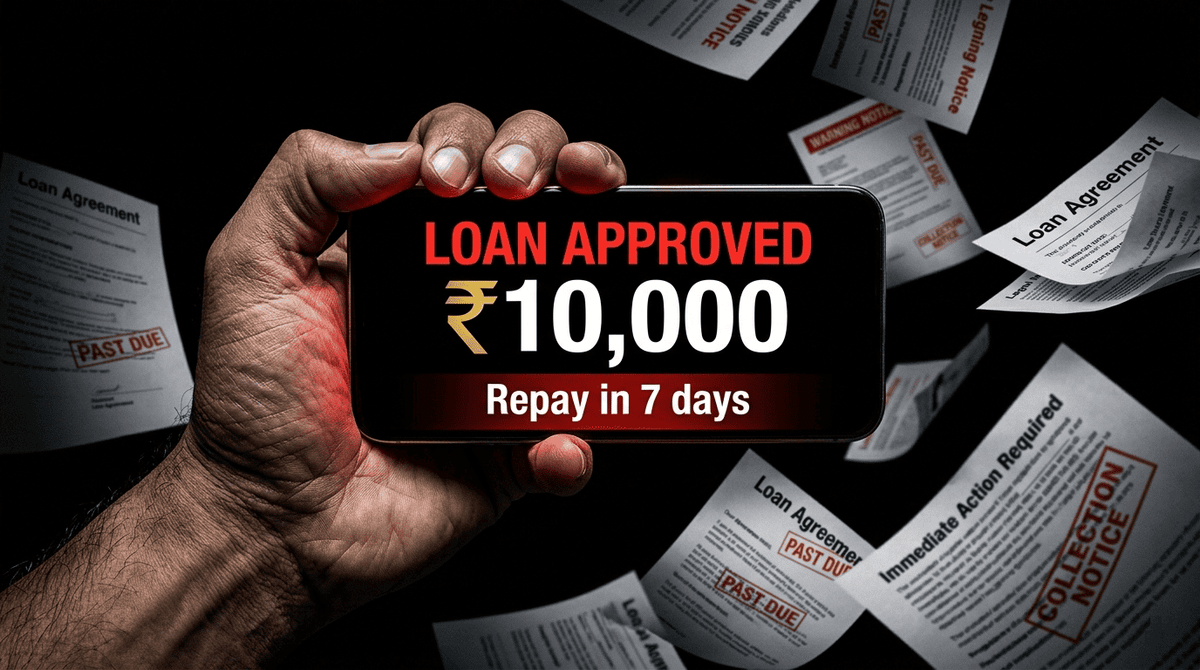
The app approves you for, say, ₹10,000. But after "processing fees," "insurance fees," "platform charges," and various other deductions, you receive ₹6,500 or ₹7,000 in your account.
You are charged interest on the full ₹10,000.
The repayment window is typically seven days. Not thirty. Not sixty. Seven.
Step 4: Default is by design
For most borrowers, repaying the full loan plus interest in seven days is impossible. This is not a bug in the system. It is the system.
The moment you miss repayment, the penalties begin compounding. And the harassment begins.
Step 5: The harassment
This is the section that is hardest to write, because the reality of what victims experience is genuinely disturbing.
Recovery agents — often operating from call centres running multiple fake apps simultaneously — begin contacting every person in your phone's contact list. Your parents. Your spouse. Your employer. Your colleagues. Your friends from ten years ago whose number you forgot you had saved.
They are told you are a fraudster and a criminal. They are shown fabricated "evidence." In documented cases reported by The Quint and others, agents have sent morphed, obscene images of borrowers to their employers and families. In 2026, AI-generated deepfake voice calls impersonating police officers have been added to the harassment arsenal. Victims receive calls from convincing "police" voices telling them an arrest warrant has been issued.
Multiple suicides across India have been directly linked to this harassment. This is not a data privacy problem. It is a public health crisis.
What changed in 2026: RBI's new rules and what they actually mean
RBI has not been idle. The 2026 digital lending framework represents the most significant regulatory tightening in the history of Indian fintech regulation. Here is what actually changed — and what it means for borrowers.
Rule 1: All disbursals must go directly to the borrower's bank account
Under the new rules, no Lending Service Provider (LSP) — the app you download — can ever hold, touch, or divert loan funds. Money must flow directly from the regulated lender to your account. This closes a major loophole that shadow lenders exploited to siphon funds before disbursal.
What this means for you: If an app tells you your loan will be disbursed to a "wallet" first, or asks you to pay any amount before receiving funds, that app is operating illegally.
Rule 2: A Key Fact Statement (KFS) is mandatory before you sign anything
Every legitimate digital loan must now come with a Key Fact Statement that clearly discloses the Annual Percentage Rate (APR — the true total cost of borrowing), all fees and charges with no hidden items, the total repayment amount, and a cooling-off period of at least three days during which you can cancel the loan at no penalty.
What this means for you: If an app asks you to agree to terms without showing you a clear KFS with the APR prominently displayed, stop immediately. The APR is the number that matters. Not the "monthly interest rate" of 2% that sounds harmless but is actually 24% annualised — and on predatory apps, can be 400% or more.
Rule 3: Your data can only be used for credit underwriting
RBI's 2026 framework explicitly prohibits digital lenders from using data collected during the loan application for any purpose other than credit assessment — including marketing, third-party data sales, or any other commercial use — without fresh, explicit consent.
What this means for you: Any app that accesses your contacts "for verification" but then contacts those people during recovery is violating both RBI guidelines and your privacy under the DPDP Act 2023. This is now grounds for a formal complaint, not just a personal grievance.
Rule 4: Only regulated entities can lend
This sounds obvious — but it is the most violated rule in the digital lending space. Only entities with a valid NBFC licence from RBI, or commercial banks, are permitted to disburse loans. Apps that facilitate lending from unregulated overseas entities or shell companies are operating illegally, regardless of how professional they look.
Rule 5: Grievance redressal with a named officer
Every legitimate digital lender must now have a clearly named Grievance Redressal Officer with contact details published on their website. If you cannot find this, the app may not be legitimate.
The three questions that separate legitimate apps from predatory ones
Given that fake apps are designed to look real, how do you actually tell the difference before it is too late?
At Fintrens, we have developed a three-question check that takes less than five minutes and catches the vast majority of predatory apps.
Question 1: Is the lender name clearly disclosed, and do they have a valid RBI NBFC registration?
Every legitimate digital loan app must prominently display the name of the regulated entity that is actually providing the loan — not just the app's brand name. That entity must have a valid NBFC or bank licence from RBI.
Check it at the RBI's official NBFC registration portal at rbi.org.in. Search for the entity name. If it does not appear, the app is not operating under RBI oversight. Stop there.
Question 2: What is the stated APR — and is it displayed before you apply?
A genuine lender is legally required to show you the APR before you commit to a loan. If the app shows you a "monthly rate" or a "daily interest" rather than an annualised figure, calculate it yourself: multiply the daily rate by 365, or the monthly rate by 12. If the result is above 36% APR, scrutinise extremely carefully. If it is above 100%, the app is almost certainly predatory.
Question 3: Does the app require access to your contacts?
Legitimate lenders have no business need for your contacts. None. Access to your contacts is how predatory apps build their harassment infrastructure. A legitimate app needs camera access for KYC, it needs storage for document upload, and it may need location for RBI compliance. It does not need your contact list. Ever. If an app will not proceed without contacts permission, deny it and move on.
If you are already in a trap: what to do right now
If you or someone you know is currently being harassed by a predatory loan app, this section is the most important thing to read.
First: Do not pay any additional "clearance fees" or "penalty removal charges." Predatory apps will tell you that a single payment will stop the harassment. This is false. Every payment confirms to them that the harassment strategy is working and extends the cycle.
Second: File a complaint with the RBI immediately. The RBI Sachet portal at sachet.rbi.org.in accepts complaints against unauthorised digital lenders. Also file with the National Cyber Crime portal at cybercrime.gov.in. Both portals have dedicated teams for loan app harassment in 2026. This is not bureaucratic box-ticking — complaints trigger investigations that can lead to app takedowns.
Third: Alert your contacts. Send a single clear message to people in your contact list explaining that they may be contacted by an illegal loan app in your name, that the messages are false, and that they should ignore any such contact. Taking control of the narrative removes the harassment tool's power.
Fourth: Uninstall the app and revoke its permissions immediately. In your phone's app permissions settings, revoke all access granted to the app. This does not erase data already collected, but it prevents further real-time data extraction.
Fifth: Speak to someone. The psychological impact of this kind of harassment — particularly when contacts, employers, and family are targeted — is severe. The iCall helpline at 9152987821 provides free mental health support and has experience with loan app harassment cases specifically.
What India's fintech ecosystem must reckon with
The predatory loan app crisis exists because legitimate financial need is not being met by the mainstream system.
The borrower who downloads a predatory app is not naive or careless. They are typically someone who needs ₹5,000–₹20,000 urgently — for a medical bill, a school fee, a utility payment — and who either does not qualify for a bank loan, does not have time for a bank loan, or does not know that better options exist. The predatory app is faster, simpler, and asks no uncomfortable questions about credit history.
India's NBFC-MFI sector, which was supposed to serve this segment, has itself been in crisis. Stress levels in the sector surged to 15.3% by March 2025, up from 5.9% a year earlier. Loan portfolios contracted 12% in FY25 — the first contraction in a decade. Underwriting standards eroded during the growth phase, overleveraging became widespread, and now the sector is contracting precisely when small borrowers need it most.
This is the gap that predatory apps fill. And closing that gap permanently requires not just regulation — which RBI is doing — but the development of genuinely accessible, trustworthy, affordable digital lending for the segment of the Indian population that currently has no good option.
That is the real challenge for Indian fintech in 2026 and beyond.
The Fintrens checklist: how to verify any loan app before applying
Save this. Share it with family.
- Search the lender's NBFC registration at rbi.org.in before touching the application
- Find the Key Fact Statement and read the APR — the full annualised rate — before agreeing to anything
- Check that the app has a named Grievance Redressal Officer with a real email address and phone number published on their website
- Never grant contacts permission to any lending app under any circumstances
- Verify that loan funds disburse directly to your bank account — no wallets, no prepayment required
- Check app reviews carefully — look for patterns of harassment complaints, not just star ratings
- If anything feels rushed or pressured, stop. Legitimate lenders do not pressure you. Predatory ones do.
The Indian government blocked six predatory loan apps on May 12, 2026. Eighty-seven were blocked in December 2025. Five hundred more are under review.
But new ones are being created faster than the old ones are being shut down.
The most powerful protection is not regulation. It is an informed public that knows exactly what to look for and refuses to be caught.
At Fintrens, building that informed public is what we are here to do.
Have you or someone you know been affected by a predatory loan app? Share your experience in the comments — your story could protect someone else.
For ongoing coverage of India's digital lending landscape, including the latest RBI updates and verified lists of licensed lenders, follow Fintrens at blogs.fintrens.com