
Your Company's ₹5 Lakh Health Cover Will Not Save You. Here Is the Math Nobody Shows You.
India's medical costs are growing at 14% a year — the fastest in Asia. The health cover most Indians are relying on was designed for a world that no longer exists.
Picture this. A family member is admitted to a private hospital in Bangalore or Mumbai for a cardiac procedure. The surgery goes well. The bill arrives.
₹8.5 lakh.
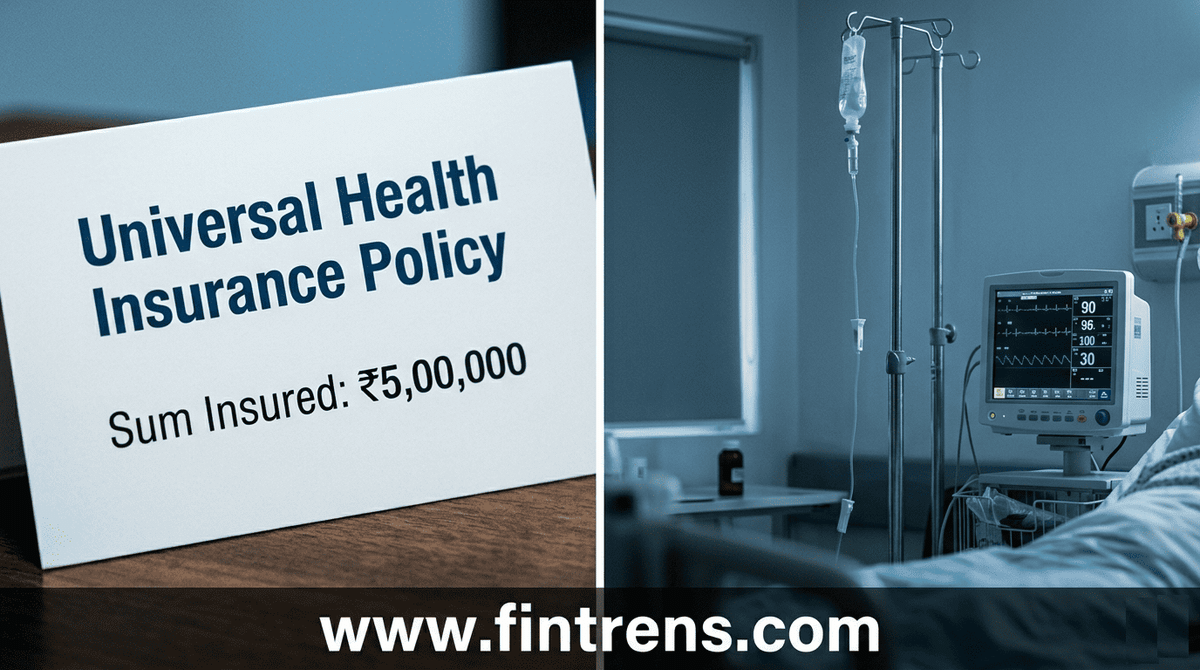
Your company health policy has a sum insured of ₹5 lakh. The insurer pays ₹5 lakh. You pay ₹3.5 lakh from your savings — money that took years to build. If you don't have it, you borrow.
This scenario is not hypothetical. It is playing out in cities across India right now, for people with employer health insurance, for people who thought they were covered, for people who did everything that seemed right.
At Fintrens, we spent time with the numbers driving this crisis. What we found is something that the insurance comparison industry, HR departments, and most financial content in India consistently fails to say clearly:
The health cover most salaried Indians are relying on was obsolete before they received it.
The 14% Problem
India's medical inflation — the rate at which healthcare costs are rising — is running at approximately 14% annuallyin 2026. That makes India the highest medical inflation market in Asia, significantly above the global average of 9.8%.
To understand what 14% annual inflation means in practice, consider the Rule of 72: divide 72 by the inflation rate to get the number of years it takes for costs to double. At 14%, medical costs in India double every 5.1 years.
A medical procedure that costs ₹5 lakh today will cost approximately ₹10 lakh in five years. In ten years, ₹20 lakh. The cover that feels adequate now is structurally becoming less adequate every single month.
This is not the inflation rate of a bad year. It is an entrenched structural reality driven by the convergence of several factors: the rapid adoption of expensive medical technologies (robotic surgeries, advanced imaging, targeted oncology therapies), rising specialist fees, premium hospital infrastructure expanding faster than doctor supply, and the cost of imported drugs and medical equipment.
Insurance companies know this. Individual policy premiums have risen 23% between FY23 and FY25. Family floater premiums have risen 46% in the same period — from approximately ₹15,000 in 2021 to over ₹22,000 in 2025, and continuing to rise. Premiums are expected to climb another 10–15% in the next 12–18 months.
The insurers are repricing for the reality of what healthcare actually costs. Most of their policyholders are not.
Why ₹5 Lakh Is the Wrong Number
The ₹5 lakh sum insured is the default across Indian employer health policies and an enormous proportion of individual retail policies. It is the number that HR departments quote when explaining benefits. It is the number on most comparison sites when you search for "affordable health insurance."
How did ₹5 lakh become the standard? It was not derived from the cost of actual medical procedures. It was derived from what employers were willing to spend on group premiums and what insurers could profitably offer at low ticket sizes. It is a commercial floor, not a medical reality.
Here is what ₹5 lakh covers in 2026 in a Tier 1 private hospital — and what it does not.
Procedures typically within ₹5 lakh:
- Appendectomy: ₹60,000–₹1.5 lakh
- Knee replacement (single): ₹2.5–₹4 lakh
- Cataract surgery: ₹40,000–₹80,000 per eye
- Normal delivery (C-section included): ₹80,000–₹2 lakh
- Dengue hospitalisation: ₹50,000–₹1.5 lakh
Procedures that routinely exceed ₹5 lakh in 2026:
- Cardiac bypass surgery (CABG): ₹4–₹8 lakh
- Cancer treatment (chemotherapy cycles, 6 months): ₹8–₹25 lakh
- Kidney transplant: ₹8–₹12 lakh
- Stroke with ICU care: ₹5–₹15 lakh
- Liver transplant: ₹20–₹35 lakh
- Accident with multiple injuries and ICU: ₹6–₹20 lakh
The procedures that ₹5 lakh covers cleanly are the ones you survive without financial damage anyway. The procedures where adequate insurance matters — the catastrophic, extended, complex cases — are precisely the ones that exceed it.
At 14% annual medical inflation, even the procedures currently within ₹5 lakh will breach that ceiling within 3–5 years.
The Company Cover Trap
For most salaried Indians, the health insurance conversation starts and ends with: "My company gives me cover." This is the most dangerous assumption in Indian personal finance.
Here is what that assumption is missing.
Your company cover ends the moment you leave.
Resignation. Layoff. Retirement. A startup winding down. A contract not renewed. The day you stop being an employee is the day your health cover disappears. And this happens at exactly the moments when buying fresh individual insurance becomes hardest — because you may be between jobs, under financial stress, or (in the case of retirement) older and therefore significantly more expensive to insure.
Buying health insurance in your 50s or 60s — the period when you are most likely to actually need it — is dramatically more expensive than buying it in your 30s. Pre-existing conditions acquired during your working life may be excluded for waiting periods of 2–4 years. The cover you are offered may have sub-limits and caps that were not in your employer policy.
Your company cover probably has sub-limits you have not read.
Most group employer policies have sub-limits on specific items: room rent (often capped at 1% of sum insured per day, meaning ₹500 per day on a ₹5 lakh policy — below the cost of a standard hospital room in any Tier 1 city), ICU charges, specific surgery types, and consultation fees.
These sub-limits mean your effective cover is often significantly less than the headline ₹5 lakh. If your room rent exceeds the sub-limit, the insurer can proportionally reduce the claim on the entire hospitalisation — not just the room charge.
Your company cover excludes your parents entirely.
The people most likely to need expensive hospitalisation — your parents — are often not covered under your employer policy, or are covered only as an expensive add-on. A 65-year-old parent with hypertension or diabetes is exactly the financial exposure that requires the most cover. Employer policies rarely provide it adequately.
Your company cover does not keep up with inflation.
The ₹5 lakh cover you received when you joined in 2021 is still ₹5 lakh in 2026 — while medical costs have risen by approximately 90% in the same period (at 14% annual inflation). The policy has not been adjusted. Its real-world purchasing power has halved.
What Adequate Health Cover Actually Looks Like in 2026
The insurance industry's guidance has shifted significantly in the last two years. Here is what qualified health insurance advisors and actuaries are now recommending for different situations.
For an individual (age 25–35) in a metro city: Minimum sum insured: ₹15–₹20 lakh
This sounds like a lot compared to the ₹5 lakh standard. It is not excessive. At 14% medical inflation, ₹15 lakh today will retain the purchasing power of ₹10 lakh in five years. A serious illness — cancer, cardiac event, major accident — can easily consume ₹8–₹15 lakh in a metro hospital.
For a family floater (couple + children, primary earner age 35–45): Minimum sum insured: ₹25–₹50 lakh
Family floater policies share the sum insured across all members. If two family members have significant claims in the same year, the cover is exhausted faster. At the scale of procedures now common — cancer treatment, cardiac surgery, post-accident care — a ₹10 lakh family floater is insufficient for a single serious event, let alone two.
For a family including senior citizen parents (above 60): Minimum sum insured per parent: ₹25–₹50 lakh, separate individual policy
Senior citizens should ideally have their own individual policies rather than being added to family floaters. Their claims frequency and severity are significantly higher, and including them in a family floater both increases premium disproportionately and risks exhausting the cover for the entire family on a single parent's hospitalisation.
The Super Top-Up: The Most Underused Product in Indian Insurance
Here is where the coverage gap becomes practical and affordable to fix.
Most Indians assume that raising their sum insured from ₹5 lakh to ₹20 lakh means buying a fresh ₹20 lakh policy and paying the full premium. That assumption is wrong.
The super top-up health insurance plan is designed precisely for this situation — and it is dramatically cheaper than increasing your base cover.
A super top-up plan activates above a threshold — called the deductible — and covers costs beyond that threshold up to a higher sum insured. If your base policy (employer or individual) covers ₹5 lakh, a super top-up with a ₹5 lakh deductible and ₹25 lakh additional cover kicks in for any hospitalisation bill above ₹5 lakh.
What this costs: A ₹25 lakh super top-up plan with a ₹5 lakh deductible for a 35-year-old individual from a reputable insurer typically costs ₹5,000–₹8,000 annually.
Compare that to the cost of buying a fresh ₹25 lakh base policy: ₹15,000–₹25,000 annually.
The super top-up gives you ₹25 lakh of additional coverage for approximately one-third to one-fourth the premium of a standalone policy of the same size. It is one of the highest-value, lowest-utilised products in Indian insurance.
Important caveat: Super top-ups work most effectively when the deductible matches your reliable existing cover. If your employer cover is your only base cover, verify whether it covers the full deductible amount if you leave the company mid-year. For the most robust setup, maintain both a personal base policy (₹5–₹10 lakh) and a super top-up — so your coverage is not dependent on your employment status.
The Specific Gaps Most Indians Are Not Covering
Beyond the sum insured question, several specific coverage gaps affect a large proportion of Indian policyholders.
Cancer cover. Standard health insurance covers hospitalisation for cancer — chemotherapy, surgery, radiation — but typically only during hospitalisation. Oral chemotherapy, targeted therapy drugs administered at home, and outpatient oncology consultations are frequently excluded or sub-limited. In 2026, a significant proportion of advanced cancer treatment happens outside hospitalisation settings. Critical illness cover that pays a lump sum on diagnosis — regardless of treatment setting — fills this gap.
Mental health cover. The Mental Healthcare Act 2017 mandated that health insurers cover mental illness on par with physical illness. In practice, implementation has been uneven. Many group policies have restrictive definitions, short hospitalisation limits, or sub-limits on psychiatric treatment. Check your policy specifically for this.
OPD (outpatient) costs. The bulk of most people's annual healthcare spending is not hospitalisation — it is consultations, diagnostics, and medicines. Standard health policies do not cover OPD expenses. Policies with OPD riders exist and are worth considering for families with children or chronic conditions requiring frequent consultations.
Waiting periods for pre-existing conditions. If you have diabetes, hypertension, thyroid conditions, or any documented pre-existing condition, most health policies impose a waiting period of 2–4 years before covering treatment related to that condition. The earlier you buy a policy — before conditions develop — the better your coverage position for life.
Room rent sub-limits. This is the trap most people discover on their first claim. If your policy caps room rent at 1% of sum insured per day, your ₹5 lakh policy allows ₹500/day for hospital room rent. Most private hospitals in Tier 1 cities charge ₹3,000–₹12,000/day for a standard room. When you exceed the sub-limit, the insurer may reduce the entire claim proportionally — not just the room charge. Always choose policies with no room rent sub-limits, or with limits set to the actual cost of a standard hospital room.
The Three Steps to Fix This Before You Need It
The uncomfortable truth about health insurance is that the time to fix it is now — when you are healthy, not when you are in a hospital admission queue filling out forms.
Step 1: Calculate your real coverage requirement.
Start with your city and your family structure. For a Tier 1 city (Mumbai, Bangalore, Delhi, Chennai, Hyderabad, Pune), minimum adequate individual cover is ₹20 lakh in 2026. Add ₹5 lakh to that number for each year you expect to keep the same policy (at 14% inflation, you need the buffer). For a family of four, ₹50 lakh is the floor, not the ceiling.
Step 2: Identify the gap and fill it with a super top-up.
Total your existing cover — employer policy plus any individual policy you hold. Subtract that from your adequate coverage number. The difference is your gap. A super top-up plan with a deductible equal to your existing cover fills that gap at the lowest possible premium. Compare plans from Star Health, Niva Bupa (formerly Max Bupa), Care Health, and HDFC Ergo — all offer competitive super top-up products.
Step 3: Buy an individual base policy that is not tied to your employment.
If your only health cover is your employer policy, you are one job transition away from being uninsured. A personal base policy of ₹5–₹10 lakh — maintained independently of your employer — provides continuity through career changes and ensures your super top-up deductible is always covered. Buy it when you are young and healthy. Waiting costs you more in premiums and risks exclusions for conditions acquired later.
The Fintrens Checklist: Health Insurance Audit
Run this audit on your current health cover before the next policy renewal.
- What is your total sum insured? Add employer cover + any personal policy. If it is below ₹15 lakh for an individual or ₹25 lakh for a family in a Tier 1 city, you are underinsured.
- Does your employer policy have room rent sub-limits? Check the policy document specifically. If it caps room rent at 1% of sum insured, the cover is significantly less effective than the headline number suggests.
- Are your parents covered — and by what? If they are over 60 and covered only by your employer policy's optional parental add-on, check the actual sum insured and sub-limits for that cover specifically.
- What happens to your health cover if you leave your current employer tomorrow? If the answer is "nothing, I'm covered until the end of the policy year" — verify that. If the answer is "I'd have no cover" — fix it this week.
- Do you have a super top-up plan? If not, and your base cover is below ₹20 lakh, get quotes from three insurers this month. The premium will be considerably lower than you expect.
- Does your policy cover cancer treatment on an outpatient basis? If you are not sure, call your insurer and ask specifically. If not, consider a separate critical illness cover that pays lump sum on diagnosis.
- When did you last increase your sum insured? If it has been more than three years, your real coverage has declined by approximately 50% in purchasing power terms. A sum insured enhancement — either by endorsement on an existing policy or by upgrading to a higher plan — should be considered.
India's medical inflation is not a temporary anomaly. The combination of an ageing population, rising incidence of lifestyle diseases, rapid adoption of expensive treatment protocols, and growing demand for premium hospital infrastructure means healthcare costs in India will continue rising faster than general inflation for the foreseeable future.
The gap between what the average Indian is covered for and what a serious illness actually costs is widening every year.
At Fintrens, we think that gap needs to be named plainly. Not with disclaimers about consulting a financial advisor. With actual numbers, actual procedures, and an honest assessment of what "covered" really means in India in 2026.
For independent, honest analysis of India's personal finance landscape — follow Fintrens at blogs.fintrens.com
If this changed how you think about your health cover — share it with a family member who still thinks their company policy is enough. The conversation could be the most important one you have this year.